Olivia Stephens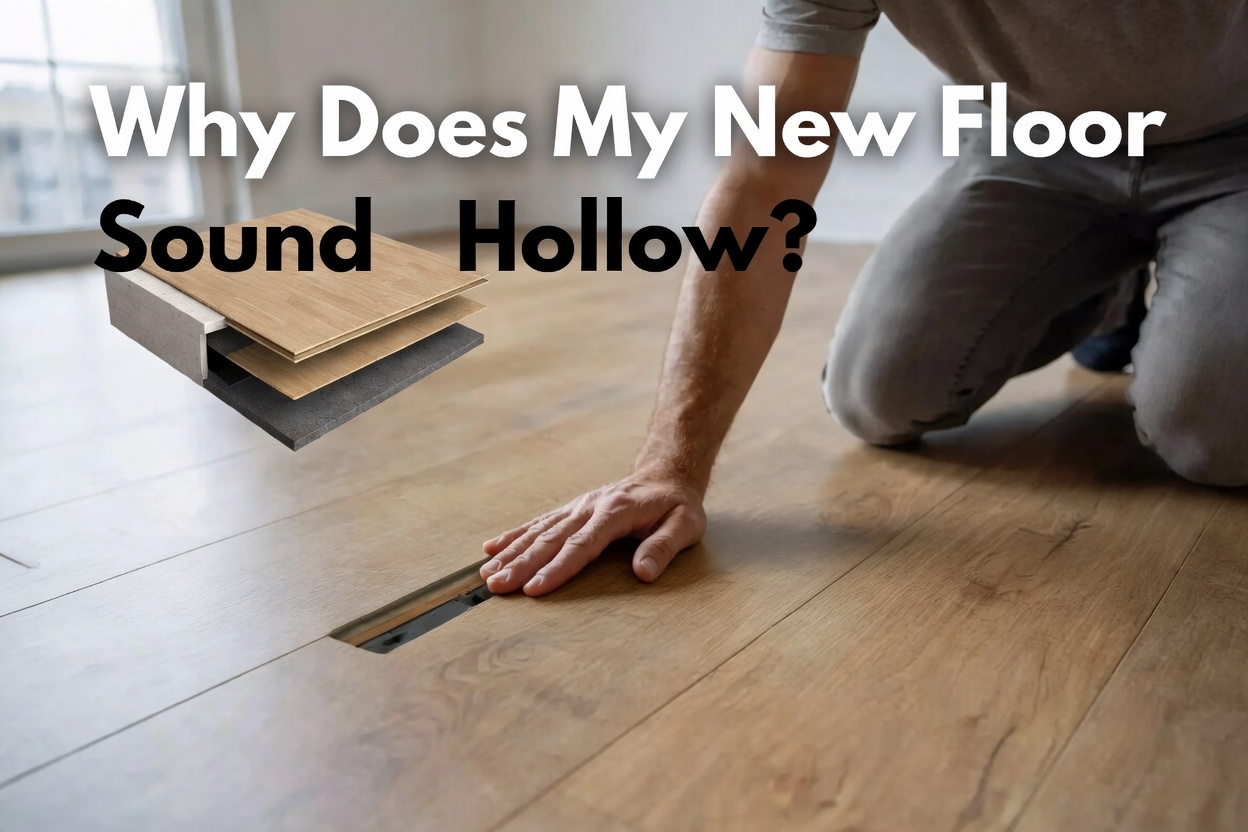
You’ve just had a brand-new floor laid. It looks fantastic. Then you walk across it and suddenly hear that dull, hollow thud beneath your feet in certain spots. You begin to question whether the floor fitter made an error, whether the solid oak flooring is flawed, or whether you’ve invested a substantial amount of money in something that will lead to future issues.
Now, what you need to understand is that hollow spots are more common on wood flooring than most people realise. And often, they’re completely normal. However, in some instances, the hollow spots are not normal, and this article will help you understand how to distinguish between normal and abnormal situations.
First, Understand What’s Actually Happening Underfoot
When a floor sounds hollow, it means there’s an air gap between the underside of the board and the subfloor beneath it. Sound travels differently through air than through solid material. So, when you step on a board that isn’t making full contact with the subfloor, you hear that distinctive thump instead of a solid, quiet step.
This can happen with any floating floor. Therefore, it affects engineered oak herringbone flooring and other such flooring options that the homeowners choose for budget renovations. It’s not specific to one product or one price point. What matters is why it’s happening, and this information will help you figure out what must be done next.
Reason 1: The Subfloor Wasn’t Flat Enough Before Installation
This issue is the most common cause which happens only by a considerable margin. Most of the floor needs a subfloor that is flat within 3mm over a 2-metre span. If your floor fitting goes beyond that tolerance, the boards will form a bridge over low spots rather than sitting flush against the surface.
When a board bridges a dip, it has nothing solid underneath it in that particular area. And therefore, stepping on it causes that hollow sound. Step on the edge of the same board where it does make contact, and it sounds perfectly fine.
The frustrating part is that the issue often isn’t apparent until the floor is fully laid and you start walking across it. A good fitter will use a long straightedge or spirit level to check the subfloor before laying anything. Apart from these issues, some subfloor problems only become apparent once furniture is moved and traffic patterns change.
What Can Be Done About It?
Minor and limited hollow spots often cause no long-term damage and can be tolerated. However, if there are large sections affected, or if the boards are flexing noticeably underfoot, the floor may need to come up so the subfloor can be levelled properly with a self-levelling compound. Before making that decision, it’s advisable to seek a second opinion from a flooring specialist.
Reason 2: The Underlay Isn’t Doing Its Job
Underlay plays a bigger role than most people appreciate. A good underlay compresses slightly underfoot and fills minor imperfections between the board and the subfloor. A poor-quality underlay or maybe one that’s too thin for the application doesn’t do this job effectively. Therefore, small air pockets form beneath the boards and produce hollow sounds when walked on.
Does Underlay Thickness Matter?
Yes, but it’s not just about thickness. Density matters equally. A very thick but low-density foam underlay can actually compress unevenly over time, creating more hollow spots than a thinner, denser product would. Look for underlays with a consistent tog rating and compression resistance suitable for the floor type you’re laying. For engineered oak herringbone flooring specifically, make sure the underlay is also compatible with the laying pattern, since herringbone puts boards at angles that create slightly different pressure distribution compared to straight planks.
Reason 3: The Glue-Down Method Wasn’t Used Where It Should Have Been
Some floors, like laminate flooring in the UK, or particularly tongue-and-groove engineered boards, perform better when glued down rather than floated. A floating installation means the boards click or lock together and essentially rest on top of the subfloor without being fixed to it. This is perfectly fine in many situations. However, in larger rooms, rooms with underfloor heating, or rooms with subfloors that have minor irregularities, glueing down the boards eliminates hollow spots almost entirely because each board is bonded directly to the surface beneath it.
If your fitter chose a floating installation in a situation where glueing down would have been more appropriate, hollow spots are a predictable outcome. It doesn’t necessarily mean anything was done wrong, as floating floors, like any affordable engineered flooring, are genuinely suitable for the vast majority of domestic installations. But it’s important to know, as the method of installation influences sound as much as the product itself.
Reason 4: Moisture Has Caused the Boards to Move
This one is something that you must take very seriously. If you have hollow spots that weren’t there when the floor was first laid, or if the hollow areas seem to be spreading or changing, moisture is a possible explanation.
Wood and moisture have a complicated relationship. Even engineered flooring, which handles humidity changes far better than solid wood, will move if exposed to significant moisture over time. When boards absorb moisture, they can cup slightly, which means the edges lift away from the subfloor while the centre stays down, or vice versa. Either way, you end up with hollow spots.
This is particularly relevant for ground-floor installations over concrete subfloors. Concrete holds moisture and releases it slowly. Without a proper damp-proof membrane beneath the floor, that moisture travels upward into the boards over months. You often don’t notice the hollow spots until they appear, and by this time, the damage has already occurred to the boards closest to the subfloor.
How Do You Tell If Moisture Is the Cause?
Look for other signs alongside the hollow sound. Are the board edges slightly raised? Is there any discolouration along the joints? Does the floor feel different to walk on in different seasons, like more hollow in winter when the underfloor heater is running or in humid summer months? Any of these alongside the hollow sound suggests moisture is involved. In that case, get a moisture reading from a specialist before doing anything else.
Summing Up
To sum up, hollow spots in your flooring are not always the problem. Understanding the underlying cause is crucial, as it equips you with the knowledge of what actions to take when necessary.

 Daniel Jack
 sojim sojim