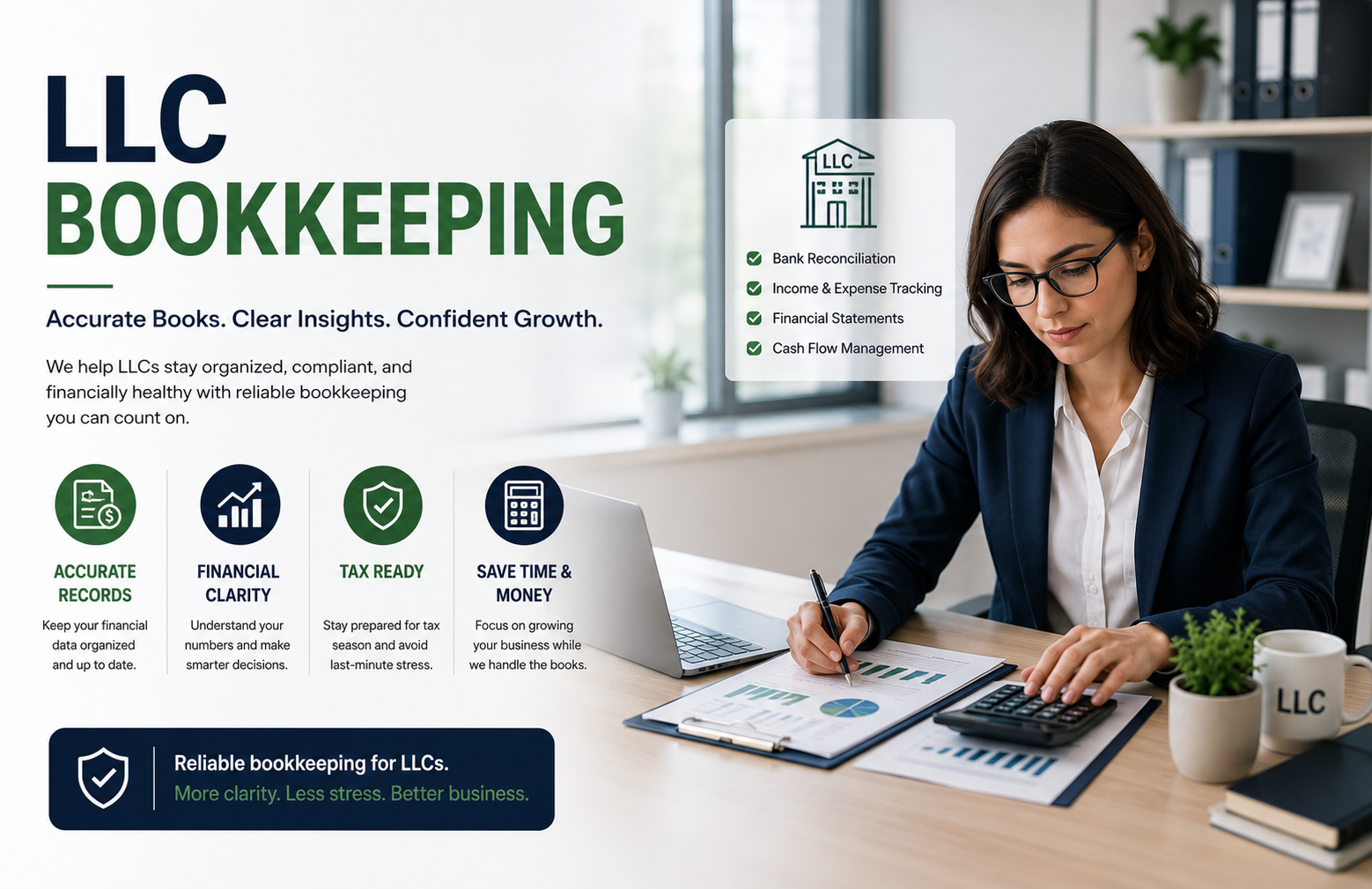
LLC Bookkeeping Made Simple: What Every Business Owner Should Know

Running an LLC comes with plenty of responsibilities. You have customers to serve, bills to pay, employees or contractors to manage, and business decisions to make. The last thing you want is to spend every evening trying to figure out where your money went.

That is where LLC bookkeeping becomes important.

Good bookkeeping is more than entering numbers into accounting software. It gives you a clear picture of your business finances, helps you prepare for taxes, keeps your records organized, and gives you the information you need to make smarter decisions.

The good news? Bookkeeping does not have to be complicated.

What Is LLC Bookkeeping?

LLC bookkeeping is the process of recording, organizing, and tracking the financial transactions of a limited liability company.

This includes recording money coming into the business, money going out, customer payments, business expenses, invoices, and other financial activity.

For example, imagine your LLC receives $15,000 from customers during the month and spends $9,000 on payroll, software, rent, supplies, and other expenses.

Bookkeeping helps you accurately track those transactions so you can understand your business’s financial position.

At a basic level:

Revenue − Expenses = Profit

But good bookkeeping goes beyond that simple calculation.

It helps you understand where your money is coming from, where it is going, what you owe, and what customers still owe you.

Why Bookkeeping Matters for an LLC

Many business owners think bookkeeping is something they only need when tax season arrives.

That is a mistake.

Your financial records should be useful throughout the entire year.

Accurate bookkeeping can help you:

  • Monitor business income
  • Track expenses
  • Understand profitability
  • Manage cash flow
  • Prepare for tax filings
  • Identify unnecessary spending
  • Track unpaid customer invoices
  • Monitor outstanding bills
  • Make better business decisions

Imagine discovering that your revenue increased by 20% but your expenses increased by 35%.

Without organized financial records, you may not notice the problem until cash becomes tight.

With accurate bookkeeping, you can identify the change earlier and take action.

Separate Your Business and Personal Finances

One of the most important bookkeeping habits for an LLC owner is keeping business and personal finances separate.

Use a dedicated business bank account and, where appropriate, a separate business credit card.

Avoid paying personal expenses directly from your business account or mixing personal purchases with business transactions.

Why does this matter?

Separating finances makes your records easier to maintain and helps you clearly identify business income and expenses.

It can also make financial reporting and tax preparation much easier.

Think of your business finances as their own financial system. The cleaner that system is, the easier it is to understand how your company is performing.

Track Every Business Expense

Small expenses can easily add up.

Software subscriptions, office supplies, professional services, advertising, travel, banking fees, equipment, and other costs should be properly recorded and categorized.

Do not rely on memory.

A $25 software subscription may not seem important, but dozens of small recurring expenses can significantly affect your annual costs.

Reviewing expenses regularly can also reveal subscriptions or services you no longer need.

Good bookkeeping does not just tell you how much you spent. It helps you understand what you spent it on.

Keep Business Receipts and Records Organized

Receipts and financial documents are important parts of your bookkeeping records.

Instead of keeping paper receipts in random folders or boxes, consider using a digital document management system.

Organize records by categories such as:

  • Office expenses
  • Travel
  • Equipment
  • Professional services
  • Advertising
  • Utilities
  • Insurance
  • Business meals

Digital organization can make it much easier to find supporting documentation when you need it.

Stay on Top of Invoices and Accounts Receivable

Making sales does not necessarily mean you have collected the money.

Suppose your LLC invoices customers $50,000 this month but only collects $30,000.

Your accounting records should clearly show the remaining $20,000 as outstanding receivables.

Regularly reviewing unpaid invoices can help you identify late payments and improve cash-flow management.

A business can be profitable on paper and still experience cash-flow problems when customers take too long to pay.

That is why tracking accounts receivable is an important part of LLC bookkeeping.

Don’t Forget Accounts Payable

The same principle applies to money your business owes.

Accounts payable includes unpaid bills and obligations to vendors or service providers.

Keeping track of upcoming payments helps you avoid missed deadlines, late fees, and unnecessary financial stress.

A simple accounts payable schedule can show:

Who you owe → How much you owe → When it is due

This gives you a clearer picture of your upcoming cash requirements.

Reconcile Your Accounts Regularly

Bank reconciliation is one of the most important bookkeeping tasks.

It involves comparing your accounting records with your bank statements to make sure the transactions match.

Regular reconciliation can help identify:

  • Missing transactions
  • Duplicate entries
  • Incorrect amounts
  • Bank fees
  • Unrecorded payments
  • Potential fraudulent activity

Waiting until the end of the year to reconcile accounts can make errors much harder to find.

Monthly reconciliation is a much better habit for most businesses.

Use Accounting Software

Modern accounting software can make LLC bookkeeping significantly easier.

Cloud-based accounting platforms can help automate tasks such as transaction imports, invoicing, expense tracking, reconciliation, and financial reporting.

Automation can reduce manual data entry and save time, but software does not eliminate the need for proper bookkeeping.

Incorrectly categorized transactions can still produce inaccurate financial reports.

The goal should be to combine good accounting processes with appropriate technology.

Understand Your Financial Reports

You do not need to become an accountant, but you should understand the basic financial reports generated by your bookkeeping system.

Three important reports are:

Profit and Loss Statement

Shows revenue, expenses, and profit over a specific period.

Balance Sheet

Shows the company’s assets, liabilities, and equity at a particular point in time.

Cash Flow Statement

Shows how cash moves into and out of the business.

Together, these reports provide a much clearer picture of financial health.

Bookkeeping vs. Accounting: Are They the Same?

Not exactly.

Bookkeeping primarily focuses on recording and organizing financial transactions.

Accounting takes those records further by analyzing financial information, preparing reports, supporting tax compliance, and helping businesses understand their financial position.

A simple way to remember it is:

Bookkeeping records the numbers. Accounting explains the numbers.

Both can be important as your LLC grows.

Should You Handle Bookkeeping Yourself?

Some LLC owners can manage basic bookkeeping themselves, particularly when the business has relatively few transactions.

However, bookkeeping can become time-consuming as the company grows.

You may eventually have more customers, employees, vendors, transactions, invoices, and financial accounts to manage.

At that point, outsourcing bookkeeping can free up valuable time while giving you access to experienced professionals.

The right choice depends on your transaction volume, financial complexity, available time, and confidence in managing your books.

Common LLC Bookkeeping Mistakes to Avoid

A few mistakes can create unnecessary problems.

Avoid:

  • Mixing personal and business expenses
  • Waiting until tax season to update your books
  • Ignoring unpaid invoices
  • Failing to reconcile bank accounts
  • Losing receipts and financial documents
  • Categorizing expenses incorrectly
  • Forgetting recurring subscriptions
  • Relying entirely on memory
  • Ignoring cash flow
  • Treating bookkeeping as an afterthought

Small mistakes can become much bigger problems when they accumulate over time.

Final Thoughts

LLC bookkeeping does not need to be overwhelming.

The basic goal is simple: keep accurate, organized, and up-to-date financial records.

Separate business and personal finances, track income and expenses, stay on top of invoices and bills, reconcile accounts regularly, maintain supporting documents, and use accounting technology appropriately.

Most importantly, do not wait until tax season to look at your books.

Your financial records are not just paperwork for the IRS. They are one of the most useful tools for understanding how your business is performing.

When your bookkeeping is accurate, you can see where your business stands today—and make better decisions about where you want it to go tomorrow.

Related Posts

Окна в Москве после установки: пять фраз, которые лучше не произносить через месяц

Представим, что ремонт закончен. Новые окна в москве уже установлены, откосы готовы, мебель вернулась на свои места, строительная пыль убрана. Технически всё работает, но через несколько недель хозяева начинают замечать…

The modern corporate landscape is moving faster than ever. Between the rapid adoption of automation, shifting workplace values across generations, and the constant demand for operational efficiency, human resource leaders face a critical challenge: How do you build a workforce that doesn’t just keep up, but actively drives market growth? Many organizations pour significant portions of their annual budget into standard, off-the-shelf workshops. Yet, a few weeks after the session, employees often slip right back into old habits. The truth is that generic training fails because it treats unique business ecosystems with a one-size-fits-all brush. To see a genuine return on your investment, your upskilling strategy needs to be as dynamic and tailored as your business goals. Here is a look at why traditional training models are broken, and how modern organizations are restructuring their learning and development (L&D) strategies for lasting success. The Pitfall of the “One-Size-Fits-All” Workshop Every organization features its own distinct internal culture, operational pain points, and cross-functional friction. When you deploy a rigid, pre-packaged training program, it fails to address the specific day-to-day challenges your employees experience on the ground. True workforce capability development requires a partner capable of building a custom architecture. Working with a dedicated provider to engineer customised corporate training solutions ensures that every module is directly aligned with your operational priorities, industry vertical, and specific skill gaps. Bridging the Leadership Gap for First-Time Managers One of the most frequent organizational missteps is promoting an exceptional technical performer or individual contributor to a managerial role without providing a proper transition framework. Managing people requires an entirely different skill set than managing tasks. Without targeted development, new leaders often struggle with delegation, team motivation, and constructive feedback loops. Implementing a structured first-time managers training program bridges this gap early, equipping emerging leaders with the behavioral tools they need to reduce team turnover and maintain high performance. For organizations aiming to cultivate long-term strategic vision at executive levels, a comprehensive leadership development program in India ensures your leadership pipeline remains robust and future-ready. Beyond Technical Know-How: The Power of Behavioral and Soft Skills Technical expertise can get your foot in the door, but behavioral alignment and communication keep the business moving forward. From handling high-stakes client negotiations to managing workplace conflict, soft skills are the silent engine of productivity. A modern L&D strategy must treat these competencies as measurable, essential skills. Investing in professional soft skills training services and targeted corporate behavioral skills training directly impacts how your teams collaborate across departments, leading to fewer project bottlenecks and smoother execution. Activating Engagement Through Experiential Learning Sitting in a conference room staring at slide decks rarely inspires behavioral change. For teams to truly absorb organizational values and learn how to collaborate under pressure, they need to experience it. This is why forward-thinking organizations are moving toward experiential models. Utilizing structured corporate team building programs or getting teams out of the office for corporate outbound & OBT training program services places employees in dynamic, hands-on scenarios. These environments break down workplace silos, build trust, and teach real-time problem-solving far more effectively than traditional lectures. Scaling Consistency Across PAN-India Operations For enterprises with regional offices, manufacturing plants, or distributed teams across the country, maintaining a uniform standard of training is incredibly difficult. Local nuances, varying trainer quality, and logistical hurdles often lead to an fragmented learning experience. To counter this, scaling organizations require a partner with deep infrastructural reach. Partnering with an organization capable of executing PAN India training projects ensures that whether your employees are based in Delhi-NCR, Mumbai, or remote locations, they receive the exact same high standard of content delivery and facilitator expertise. The Bottom Line Training shouldn’t be a check-the-box exercise to fill an HR calendar. It is a strategic business driver. When you shift away from generic presentations and focus on customized, behavior-driven learning paths, you don’t just train your employees—you elevate your entire organizational capability. If you are looking to audit your current workforce capabilities and design a high-impact learning intervention, explore the tailored programs offered by Talent Sapphire, a premier corporate training company in India dedicated to transforming organizational performance from the ground up.

The modern corporate landscape is moving faster than ever. Between the rapid adoption of automation, shifting workplace values across generations, and the constant demand for operational efficiency, human resource leaders…

Leave a Reply

Your email address will not be published. Required fields are marked *

You Missed

California Cannabis Delivery: Convenience, Selection, and What to Know

Окна в Москве после установки: пять фраз, которые лучше не произносить через месяц

Окна в Москве после установки: пять фраз, которые лучше не произносить через месяц

The modern corporate landscape is moving faster than ever. Between the rapid adoption of automation, shifting workplace values across generations, and the constant demand for operational efficiency, human resource leaders face a critical challenge: How do you build a workforce that doesn’t just keep up, but actively drives market growth? Many organizations pour significant portions of their annual budget into standard, off-the-shelf workshops. Yet, a few weeks after the session, employees often slip right back into old habits. The truth is that generic training fails because it treats unique business ecosystems with a one-size-fits-all brush. To see a genuine return on your investment, your upskilling strategy needs to be as dynamic and tailored as your business goals. Here is a look at why traditional training models are broken, and how modern organizations are restructuring their learning and development (L&D) strategies for lasting success. The Pitfall of the “One-Size-Fits-All” Workshop Every organization features its own distinct internal culture, operational pain points, and cross-functional friction. When you deploy a rigid, pre-packaged training program, it fails to address the specific day-to-day challenges your employees experience on the ground. True workforce capability development requires a partner capable of building a custom architecture. Working with a dedicated provider to engineer customised corporate training solutions ensures that every module is directly aligned with your operational priorities, industry vertical, and specific skill gaps. Bridging the Leadership Gap for First-Time Managers One of the most frequent organizational missteps is promoting an exceptional technical performer or individual contributor to a managerial role without providing a proper transition framework. Managing people requires an entirely different skill set than managing tasks. Without targeted development, new leaders often struggle with delegation, team motivation, and constructive feedback loops. Implementing a structured first-time managers training program bridges this gap early, equipping emerging leaders with the behavioral tools they need to reduce team turnover and maintain high performance. For organizations aiming to cultivate long-term strategic vision at executive levels, a comprehensive leadership development program in India ensures your leadership pipeline remains robust and future-ready. Beyond Technical Know-How: The Power of Behavioral and Soft Skills Technical expertise can get your foot in the door, but behavioral alignment and communication keep the business moving forward. From handling high-stakes client negotiations to managing workplace conflict, soft skills are the silent engine of productivity. A modern L&D strategy must treat these competencies as measurable, essential skills. Investing in professional soft skills training services and targeted corporate behavioral skills training directly impacts how your teams collaborate across departments, leading to fewer project bottlenecks and smoother execution. Activating Engagement Through Experiential Learning Sitting in a conference room staring at slide decks rarely inspires behavioral change. For teams to truly absorb organizational values and learn how to collaborate under pressure, they need to experience it. This is why forward-thinking organizations are moving toward experiential models. Utilizing structured corporate team building programs or getting teams out of the office for corporate outbound & OBT training program services places employees in dynamic, hands-on scenarios. These environments break down workplace silos, build trust, and teach real-time problem-solving far more effectively than traditional lectures. Scaling Consistency Across PAN-India Operations For enterprises with regional offices, manufacturing plants, or distributed teams across the country, maintaining a uniform standard of training is incredibly difficult. Local nuances, varying trainer quality, and logistical hurdles often lead to an fragmented learning experience. To counter this, scaling organizations require a partner with deep infrastructural reach. Partnering with an organization capable of executing PAN India training projects ensures that whether your employees are based in Delhi-NCR, Mumbai, or remote locations, they receive the exact same high standard of content delivery and facilitator expertise. The Bottom Line Training shouldn’t be a check-the-box exercise to fill an HR calendar. It is a strategic business driver. When you shift away from generic presentations and focus on customized, behavior-driven learning paths, you don’t just train your employees—you elevate your entire organizational capability. If you are looking to audit your current workforce capabilities and design a high-impact learning intervention, explore the tailored programs offered by Talent Sapphire, a premier corporate training company in India dedicated to transforming organizational performance from the ground up.

The modern corporate landscape is moving faster than ever. Between the rapid adoption of automation, shifting workplace values across generations, and the constant demand for operational efficiency, human resource leaders face a critical challenge: How do you build a workforce that doesn’t just keep up, but actively drives market growth?  Many organizations pour significant portions of their annual budget into standard, off-the-shelf workshops. Yet, a few weeks after the session, employees often slip right back into old habits.  The truth is that generic training fails because it treats unique business ecosystems with a one-size-fits-all brush. To see a genuine return on your investment, your upskilling strategy needs to be as dynamic and tailored as your business goals.  Here is a look at why traditional training models are broken, and how modern organizations are restructuring their learning and development (L&D) strategies for lasting success.  The Pitfall of the “One-Size-Fits-All” Workshop Every organization features its own distinct internal culture, operational pain points, and cross-functional friction. When you deploy a rigid, pre-packaged training program, it fails to address the specific day-to-day challenges your employees experience on the ground. True workforce capability development requires a partner capable of building a custom architecture. Working with a dedicated provider to engineer customised corporate training solutions ensures that every module is directly aligned with your operational priorities, industry vertical, and specific skill gaps.  Bridging the Leadership Gap for First-Time Managers One of the most frequent organizational missteps is promoting an exceptional technical performer or individual contributor to a managerial role without providing a proper transition framework. Managing people requires an entirely different skill set than managing tasks. Without targeted development, new leaders often struggle with delegation, team motivation, and constructive feedback loops. Implementing a structured first-time managers training program bridges this gap early, equipping emerging leaders with the behavioral tools they need to reduce team turnover and maintain high performance. For organizations aiming to cultivate long-term strategic vision at executive levels, a comprehensive leadership development program in India ensures your leadership pipeline remains robust and future-ready.  Beyond Technical Know-How: The Power of Behavioral and Soft Skills Technical expertise can get your foot in the door, but behavioral alignment and communication keep the business moving forward. From handling high-stakes client negotiations to managing workplace conflict, soft skills are the silent engine of productivity. A modern L&D strategy must treat these competencies as measurable, essential skills. Investing in professional soft skills training services and targeted corporate behavioral skills training directly impacts how your teams collaborate across departments, leading to fewer project bottlenecks and smoother execution.  Activating Engagement Through Experiential Learning Sitting in a conference room staring at slide decks rarely inspires behavioral change. For teams to truly absorb organizational values and learn how to collaborate under pressure, they need to experience it. This is why forward-thinking organizations are moving toward experiential models. Utilizing structured corporate team building programs or getting teams out of the office for corporate outbound & OBT training program services places employees in dynamic, hands-on scenarios. These environments break down workplace silos, build trust, and teach real-time problem-solving far more effectively than traditional lectures.  Scaling Consistency Across PAN-India Operations For enterprises with regional offices, manufacturing plants, or distributed teams across the country, maintaining a uniform standard of training is incredibly difficult. Local nuances, varying trainer quality, and logistical hurdles often lead to an fragmented learning experience. To counter this, scaling organizations require a partner with deep infrastructural reach. Partnering with an organization capable of executing PAN India training projects ensures that whether your employees are based in Delhi-NCR, Mumbai, or remote locations, they receive the exact same high standard of content delivery and facilitator expertise.  The Bottom Line Training shouldn’t be a check-the-box exercise to fill an HR calendar. It is a strategic business driver. When you shift away from generic presentations and focus on customized, behavior-driven learning paths, you don’t just train your employees—you elevate your entire organizational capability.  If you are looking to audit your current workforce capabilities and design a high-impact learning intervention, explore the tailored programs offered by Talent Sapphire, a premier corporate training company in India dedicated to transforming organizational performance from the ground up.

What Great PTO Services Look Like for Solar Installers

What Great PTO Services Look Like for Solar Installers

BB Glow Cream for a Fresh and Luminous Look

BB Cream with SPF for Natural Coverage & Glowing Skin