Ankit Choudhary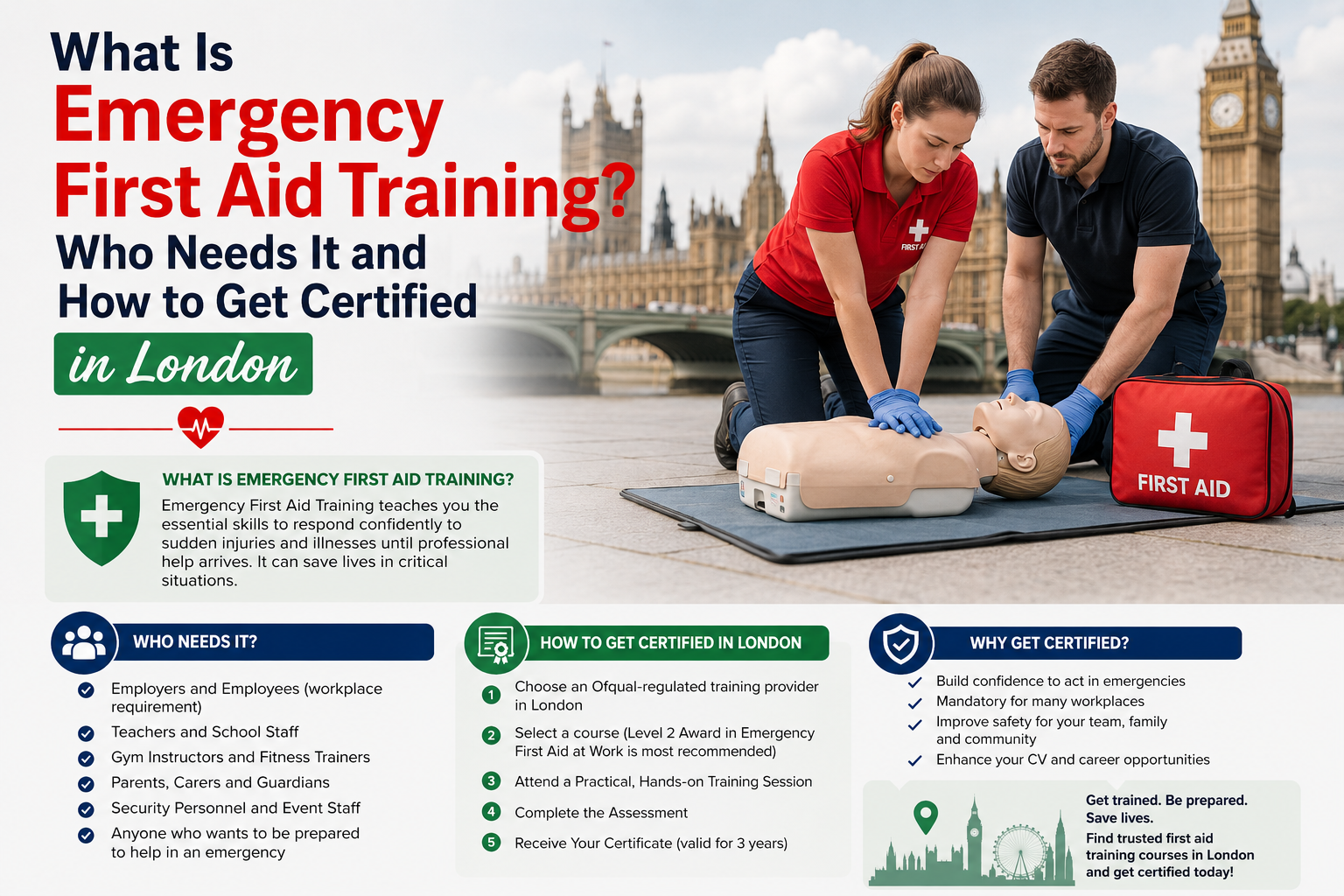
Every year in the UK, thousands of people survive cardiac arrests, severe allergic reactions, and serious workplace injuries not because a paramedic arrived in time — but because someone nearby already knew what to do. That someone was not a doctor. They were a colleague, a manager, a security officer, or a passer-by who had completed a short but structured qualification that gave them the knowledge to act under pressure.
That qualification is emergency first aid training. It is one of the most practically valuable courses a working professional can hold, and in many industries across the UK, it is either a legal requirement or a strong contractual expectation.
If you are based in London and wondering whether this course is right for you what it covers, who it is designed for, and how to get certified this article gives you a complete and honest answer.
What It Actually Is
Emergency first aid training is a one-day, accredited qualification that teaches participants how to recognise and respond to a wide range of medical emergencies. It is approved by the Health and Safety Executive and sits within the broader framework of UK first aid qualifications established under the Health and Safety (First Aid) Regulations 1981.
Unlike the full three-day First Aid at Work qualification, the emergency version is designed for environments where a rapid response to immediate threats is the priority workplaces, public venues, events, and any setting where a first aider needs to stabilise a situation and support a casualty until emergency services arrive.
The course is structured around hands-on practical instruction rather than passive classroom learning. Participants work through real-world scenarios, practise techniques on mannequins and training equipment, and are assessed on their ability to perform procedures correctly under simulated pressure.
What the Course Covers
The content of a quality emergency first aid course goes considerably further than many people expect. By the end of the day, participants should be competent in the following areas:
Cardiopulmonary Resuscitation and AED Use
CPR is the centrepiece of any emergency first aid qualification. The course teaches the correct technique for adult chest compressions, rescue breaths, and the operation of an Automated External Defibrillator. AEDs are now widely available in offices, shopping centres, transport hubs, and public spaces across London — but the majority of people nearby have never been trained to use one. That gap is precisely what this training closes.
The DR ABC Assessment Framework
Before any intervention, a trained first aider must assess the situation safely. DR ABC Danger, Response, Airway, Breathing, Circulation — is the systematic approach that prevents well-meaning bystanders from inadvertently making a situation worse. It is deceptively simple, and without training, most people skip it entirely during the stress of an actual emergency.
Managing Bleeding and Wounds
Uncontrolled blood loss is one of the leading causes of preventable death in trauma situations. Participants learn how to apply direct pressure, use sterile dressings, recognise the signs of internal bleeding, and keep a casualty stable while waiting for paramedic support.
Recovery Position
An unconscious person left on their back faces a serious risk of airway obstruction. The recovery position is one of the most straightforward and frequently needed skills in emergency care and one that requires physical practice to perform confidently and correctly.
Recognising Medical Emergencies
Cardiac arrest, stroke, anaphylaxis, diabetic crisis, epileptic seizure each presents differently and requires a different immediate response. The course equips participants to identify warning signs quickly and take the right action, including the correct use of an EpiPen in anaphylactic emergencies.
Shock Recognition and Response
Physiological shock can follow blood loss, trauma, or severe distress. Left unrecognised, it can be fatal. Participants learn the clinical signs rapid shallow breathing, pale and clammy skin, confusion or agitation and how to keep a casualty as stable as possible before professional help arrives.
Who Needs This Qualification
The short answer is: more people than currently hold it.
The Health and Safety Executive requires employers to conduct a first aid needs assessment and provide adequate cover based on their findings. For lower-risk workplaces with small teams, one trained Emergency First Aider at Work may be sufficient. For larger organisations or higher-risk environments, more trained personnel and the full First Aid at Work qualification may be required.
In practice, the following groups are most likely to need or benefit directly from this certification:
Security professionals — Door supervisors, event security staff, and SIA-licensed operatives regularly work in environments where medical emergencies occur. Crowd situations, alcohol-related incidents, and the physical nature of the role make first aid competence not just useful but often contractually required.
Construction and site workers — Physical work environments carry elevated risk of trauma, falls, and injury. Having trained first aiders on site is an HSE requirement, and the emergency qualification is the baseline standard for many site roles.
Hospitality and events staff — Large venues, festivals, restaurants, and hotels see a regular flow of incidents ranging from choking to cardiac events. Staff trained in emergency response are better placed to act effectively before medical support arrives.
Office and corporate environments — Cardiac arrest does not discriminate by workplace type. Many London employers now include emergency first aid as a standard component of staff training, particularly for senior or facilities management roles.
Teachers, teaching assistants, and childcare workers — Schools and nurseries have specific Ofsted and regulatory guidance around first aid provision. Emergency-trained staff are a core part of meeting those requirements.
Anyone who wants to be prepared — Beyond professional obligation, many people complete the course because they want the confidence of knowing they can help if something goes wrong near them at work, at home, or in public.
Why London in Particular
London’s working environment presents a specific context. High population density, major events, a large and diverse workforce across hospitality, construction, security, and transport, and the fast pace of the city’s professional culture all create conditions where medical emergencies happen regularly and the window for effective intervention is short.
The city also has a higher concentration of accredited first aid training providers than anywhere else in the UK, which means there is no shortage of options — but quality varies significantly. The key markers of a reliable course are HSE approval, small group sizes that allow hands-on practice for every participant, and instructors with genuine emergency or medical backgrounds rather than purely academic qualifications.
How to Get Certified in London
The process is straightforward. A one-day emergency first aid course is completed in a single session, typically running from morning to late afternoon. There is no prerequisite qualification required. Participants do not need prior medical knowledge or physical fitness beyond what is needed to practise CPR.
At the end of the course, participants complete a practical assessment. Those who demonstrate competence receive an HSE-approved first aid certificate, valid for three years. Renewal requires a refresher course rather than sitting the full qualification again.
Most London providers offer a choice of public course dates allowing individuals to book as a single participant and private group sessions for employers who want to train multiple staff members on a date that suits their operation. On-site delivery, where the trainer comes to your workplace, is also available and is often the most cost-effective option for teams of six or more.
The Qualification That Proves You Are Ready
There is a meaningful difference between knowing roughly what you would do in an emergency and having actually practised it under instruction. Emergency first aid training closes that gap in a single day. It produces people who are not just aware of the right actions they have performed them, received feedback, and can repeat them reliably when it counts.
For anyone working in London across security, construction, hospitality, events, or corporate environments, this qualification belongs on your CV. For employers, it belongs in your workforce.
Ready to get certified? JFK Tech Training Ltd delivers HSE-approved Emergency First Aid Training in London with expert instructors, small group sessions, and nationally recognised certification. Courses are available for individuals and workplace groups.


 Freya Parker
 Encompass Sports Therapy