John Meth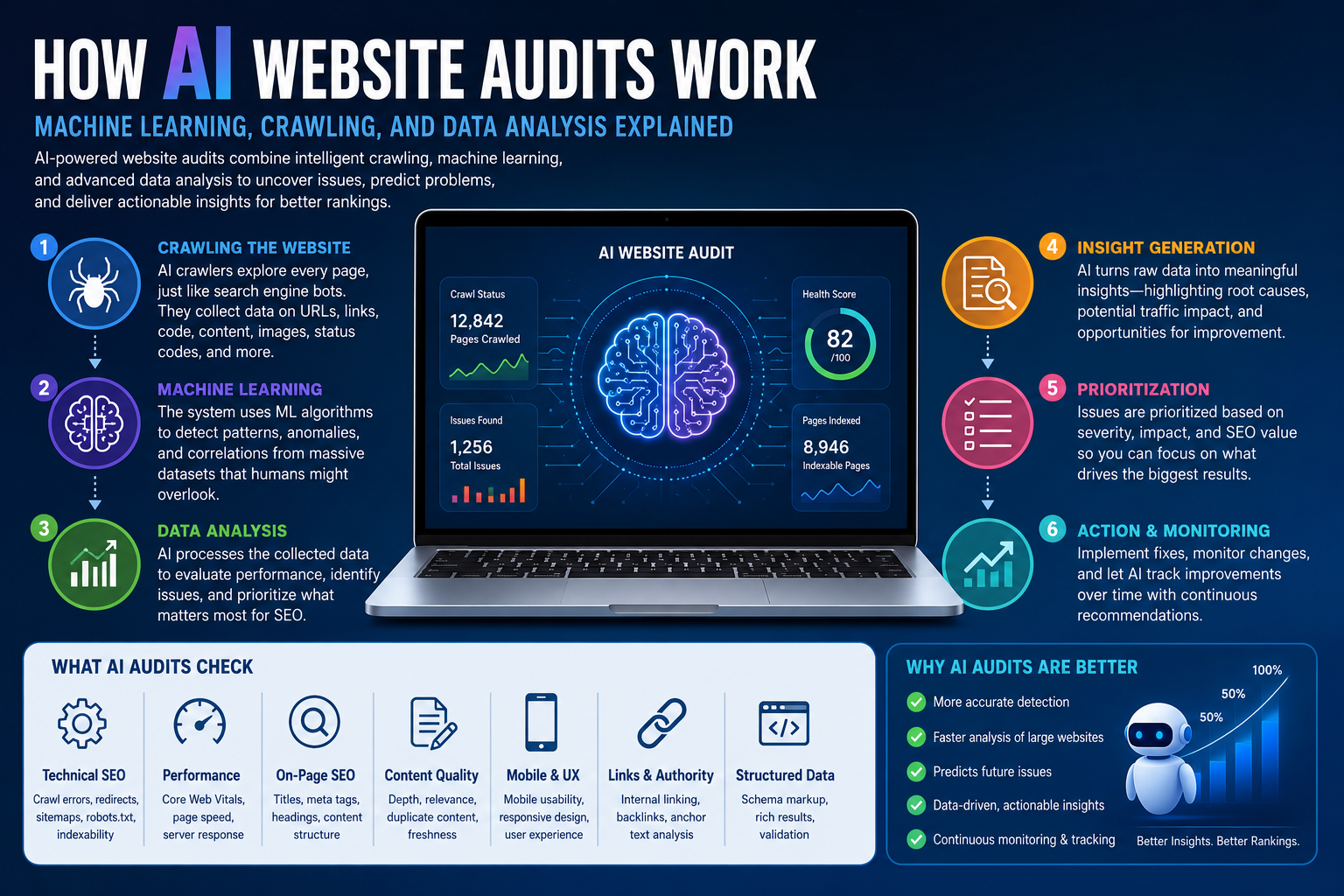
Website audits have changed dramatically over the last few years. What once required hours of manual analysis can now be completed in minutes with the help of artificial intelligence. Instead of simply listing technical issues, modern AI systems recognize patterns, compare historical performance, and identify problems that may affect rankings before they become serious.
For website owners, marketers, developers, and SEO beginners, understanding how these systems work is just as valuable as reading the final report. Once you know what happens behind the scenes, audit recommendations become easier to interpret and prioritize.
The Foundation of an AI-Powered Website Audit
Most people think an audit begins with a scan.
It actually begins with data.
An AI website SEO audit tool collects information from multiple sources before making recommendations. It combines website crawling, search engine signals, structured data validation, page performance metrics, internal linking analysis, and content quality indicators. Instead of evaluating every page in isolation, machine learning algorithms examine how these elements influence one another.
For example, if a website experiences declining rankings after a redesign, AI may correlate slower page speed, broken internal links, and metadata changes instead of treating each issue as an independent problem.
Website Crawlers: The Digital Explorers
Every intelligent audit starts with crawling.
A crawler follows links throughout a website much like a search engine bot. It records information including:
- HTTP status codes
- Canonical tags
- Internal and external links
- Meta titles and descriptions
- Heading hierarchy
- Image attributes
- Structured data
- JavaScript rendering
- XML sitemap consistency
Think of the crawler as a digital mapmaker. It documents every accessible page while identifying pages that search engines may struggle to reach.
Large websites containing thousands of URLs especially benefit from automated crawling because manually checking every page would be nearly impossible.
Machine Learning Finds Patterns Instead of Individual Errors
Traditional audit software often generates lengthy reports listing hundreds of isolated issues.
Machine learning approaches the problem differently.
Rather than asking, “Is this page missing a title tag?” the algorithm may ask, “Why are pages within this category consistently losing visibility compared to similar pages?”
This difference matters.
Instead of focusing only on technical errors, modern systems evaluate relationships between ranking signals. Many organizations, including companies such as RichestSoft, Screaming Frog, Ahrefs, SEMrush, Sitebulb, and Deepcrawl, discuss how automated pattern recognition is becoming increasingly important for handling large websites where manual analysis cannot scale efficiently.
The result is a report that highlights probable causes instead of simply counting warnings.
Data Analysis Turns Raw Information into Useful Insights
Collecting millions of data points means very little without proper interpretation.
Artificial intelligence organizes information into meaningful categories such as crawl efficiency, page experience, duplicate content, keyword cannibalization, Core Web Vitals, and backlink quality. It can compare present conditions with historical data to identify gradual declines that may otherwise go unnoticed.
Imagine tracking a website over six months. Individual reports may appear healthy, but AI can detect a steady increase in response times, growing crawl depth, declining internal authority flow, and expanding duplicate content—all before rankings noticeably drop.
That predictive capability is one reason automated auditing has become valuable for technical SEO workflows.
Content Evaluation Goes Beyond Keyword Counting
Years ago, SEO tools mainly checked keyword density.
That approach no longer reflects how modern search engines evaluate content.
Today’s AI systems analyze semantic relationships, topical coverage, readability, heading organization, entity recognition, content freshness, and search intent alignment. Instead of asking whether a keyword appears ten times, they examine whether the page thoroughly answers the user’s question.
For example, an article about technical SEO should naturally discuss crawl budget, canonicalization, indexing, structured data, internal linking, and page experience rather than repeatedly inserting the same phrase.
This creates more useful content for readers while aligning better with modern search algorithms.
Understanding Search Intent
Machine learning models often classify pages according to intent:
- Informational
- Commercial investigation
- Transactional
- Navigational
If a page targets informational searches but reads like a product page, AI may identify an intent mismatch. Correcting this disconnect often improves engagement metrics and search visibility.
Technical SEO Signals AI Commonly Reviews
An audit extends far beyond titles and descriptions.
Advanced systems evaluate dozens of technical indicators simultaneously, including:
- Core Web Vitals performance
- Mobile responsiveness
- HTTPS implementation
- Redirect chains
- Crawl depth
- Indexability
- Broken links
- Duplicate metadata
- Orphan pages
- XML sitemap accuracy
- Robots directives
- Structured data validation
- Server response times
- JavaScript rendering issues
Some platforms even assign confidence scores, helping users prioritize fixes that are most likely to influence organic performance.
Predictive Analysis Makes AI Different
Here’s where things become interesting.
Traditional software reports existing problems.
Artificial intelligence attempts to predict future ones.
Suppose your site’s response time has increased by 12% every month for four consecutive months. Rankings haven’t dropped yet, but AI models may recognize this pattern from thousands of comparable websites and recommend investigating hosting performance before search visibility declines.
This predictive element separates modern auditing from older rule-based systems.
It’s less about reacting.
It’s more about anticipating.
Why Human Expertise Still Matters
AI excels at processing enormous datasets.
Humans excel at understanding context.
An algorithm might recommend shortening every title tag, but an SEO specialist may intentionally keep certain titles longer to improve branding or click-through rate. Likewise, duplicate content warnings are not always problems if pagination, legal documentation, or regional pages require similar wording.
The strongest audit process combines automation with professional interpretation rather than relying exclusively on either approach.
Making Sense of AI Audit Reports
Receiving an audit report with hundreds of issues can feel overwhelming.
Start by grouping recommendations according to impact instead of quantity.
A practical order usually looks like this:
- Critical indexing and crawl issues
- Site performance problems
- Internal linking improvements
- Content quality enhancements
- Structured data validation
- Metadata refinements
Working through improvements in this sequence often produces clearer progress than attempting to resolve every warning at once.
Final Thoughts
Artificial intelligence has transformed website auditing from a static checklist into an ongoing analytical process. Machine learning identifies patterns, crawlers collect comprehensive technical data, and advanced analytics convert millions of signals into practical recommendations. While automation significantly improves efficiency, understanding the reasoning behind each recommendation remains essential for making informed SEO decisions. Whether you’re managing a personal blog or a large enterprise platform, reviewing findings alongside a complete website audit checklist helps ensure that technical health, content quality, user experience, and search visibility are evaluated together rather than in isolation.

 Daniel Jack
 awais khan