Emily Jones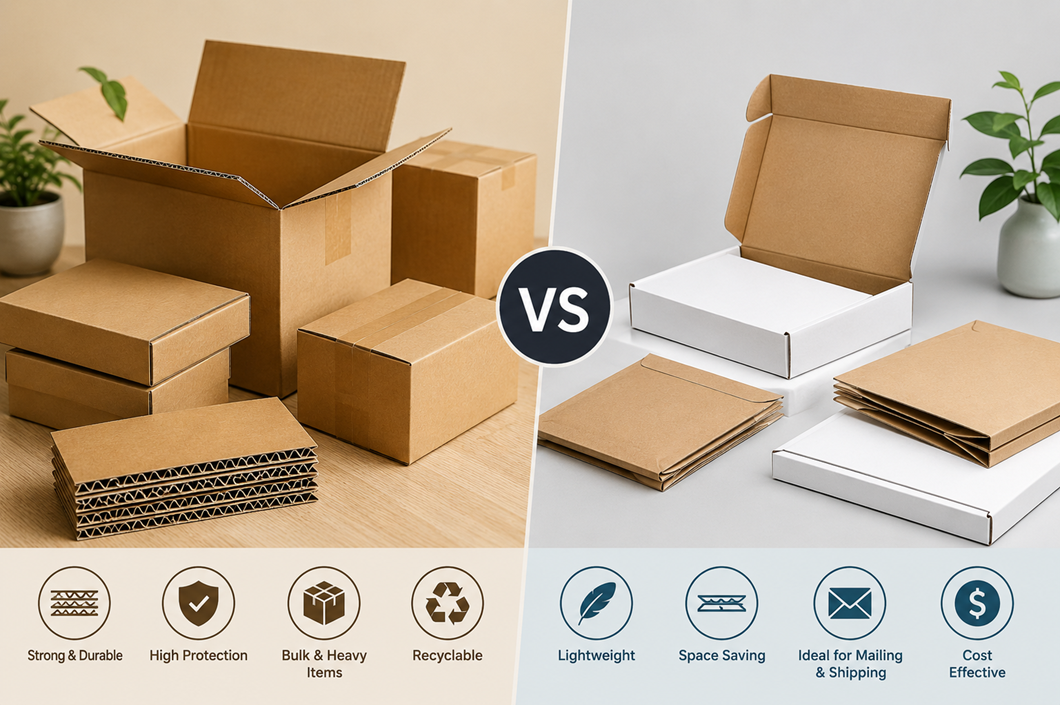
If you run an online shop, you’ve probably spent a fair amount of time staring at boxes, wondering which one will actually get your product to the customer without arriving in a crushed mess. It’s easy to call everything “cardboard,” but that’s a dangerous habit to get into. In the world of shipping, “cardboard” and “corrugated” are two completely different beasts. One is meant to look pretty on a shelf, while the other is an industrial-strength shield for your goods. Getting this wrong doesn’t just look unprofessional; it’s a direct hit to your profit margins.
What is a Cardboard Box?
When you think of a standard cereal box or a shoe box, that’s what we call cardboard—or more accurately, paperboard. It’s essentially one single, dense layer of heavy paper. A cardboard box is manufactured from a single, thick layer of heavy paper stock, often referred to in the industry as paperboard or chipboard.
Because it’s just one sheet, it’s thin, pliable, and easy to print on. It’s perfect for retail displays where the box needs to look sharp and fold cleanly. You’ll often see these used as cardboard postal boxes or flat-envelope boxes for items like stationery or t-shirts. But don’t be fooled: if you put anything heavy in there or send it through a busy courier hub, it’s going to crumple. It has no internal structure to withstand shipping pressure.
What Is a Corrugated Box?
A corrugated box is an entirely different story. It isn’t just a thick piece of paper; it’s an engineered piece of kit. It’s built by taking a wavy, fluted layer of paper and glueing it between two flat outer sheets. It is a three-layered sandwich designed to create a high strength-to-weight ratio.
That wavy middle section is the secret sauce. Those little arches act like tiny pillars, providing incredible strength. They absorb vibrations, withstand drops, and prevent the box from collapsing when things are stacked on top of it. This is why corrugated is the gold standard for postage boxes and anything that needs to survive the real world.
Which Material Is Best for Your Shipping Strategy?
Picking Cardboard
Stick with cardboard when you’re prioritising the “unboxing” experience or shipping items that can’t break.
The Best Fits: Apparel, accessories, cosmetics, or books.
The Look: It takes ink beautifully, making it the top choice for branding and logos.
Storage: Since they arrive flat and thin, they’re a godsend if you’re short on warehouse space.
Picking Corrugated
If your parcel is handled by a courier service such as DPD or Royal Mail, corrugated is non-negotiable.
The Best Fits: Glassware, electronics, heavy goods, or anything fragile.
The Protection: The air pockets in the fluting create a natural buffer that cushions your product when the box gets tossed around.
The Strength: You can stack these high in a van or on a pallet without the bottom boxes turning into pancakes.
Quick Comparison: Corrugated vs. Cardboard
| Feature | Cardboard Boxes | Corrugated Boxes |
| Material Structure | A single layer of thick paperboard or chipboard | Three layers (Two flat liners with a wavy layer inside) |
| Primary Function | Shop shelves, gift wrapping, and inner presentation | Shipping, transit protection, moving house |
| Durability and Strength | Low; punctures easily and folds under pressure | High; resists drops, heavy weights, tough handling |
| Weight & Postal Costs | Feather-light; helps you stay in lower mail tiers | Slightly heavier, depending on how thick the walls are
|
| Moisture Resistance Poor | turns to mush almost instantly when wet. Moderate | Multiple layers buy time against damp weather |
| Common Formats: | Envelope boxes, shoe boxes, cereal packets | Cardboard postal boxes, postage boxes, storage crates
|
What Are the Pros and Cons of Each Packaging Type?
Cardboard Boxes
Pros: It’s cheap, keeps your postage costs down thanks to its low weight, and makes a box look really premium when a customer opens it. Plus, it’s super easy to recycle.
Cons: It offers absolutely zero protection. If a delivery driver drops your parcel, your product feels the full force of the impact.
Corrugated Boxes
Pros: It’s a literal armour for your products. Using these means way fewer returns for broken items and much happier customers. They come in different thicknesses (single-, double-, or triple-wall) depending on how heavy your goods are.
Cons: It’s bulkier, which might bump you into a higher shipping price bracket, and it costs a bit more to buy than basic paperboard.
Summing Up
If you want to stop losing money on damaged goods, just follow this rule: Use cardboard to show off the product, but use corrugated to get it there.
If you’re shipping a hoodie, a slim cardboard postal box is perfect—it’s cheap and looks great. But if you’re shipping a ceramic mug, a bottle of perfume, or anything that can break, do yourself a favour and use a corrugated postage box. Spending a few extra pence on the right packaging is a lot cheaper than paying for a replacement product and dealing with a disappointed customer.

 Daniel Jack
 payal rajput