Manoj bhuva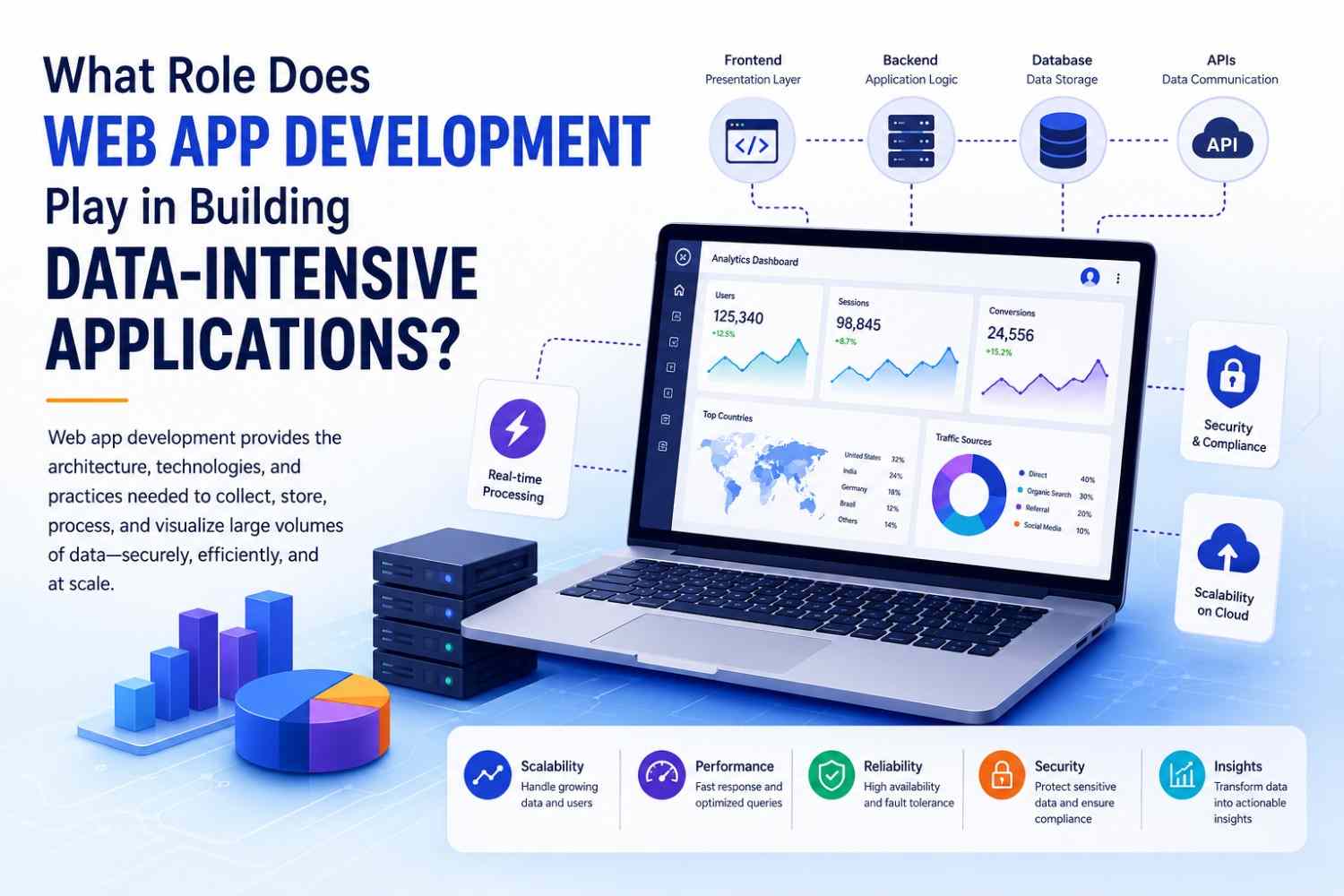
Data is no longer something businesses simply collect and store. It drives decisions, customer experiences, automation, forecasting, reporting, and day-to-day operations. From healthcare platforms processing patient records to e-commerce applications analyzing thousands of transactions, modern businesses increasingly depend on applications that can handle substantial amounts of information without slowing down.
This is where web app development becomes important. A data-intensive application needs much more than an attractive interface. It needs an architecture capable of processing, retrieving, securing, and presenting data efficiently.
We have seen a common pattern in software projects — an application works beautifully when it has a few hundred records, and suddenly starts behaving like it has developed a personal dislike for performance once the dataset grows. The problem is rarely the data itself. More often, the underlying architecture was never prepared for growth.
So, what role does web app development play in building data-intensive applications? Let’s break it down.
What Are Data-Intensive Applications?
Data-intensive applications are software systems where the volume, complexity, speed, or availability of data is a major part of the application’s workload.
Unlike applications where computation is the primary challenge, data-intensive systems spend significant resources storing, retrieving, transforming, synchronizing, and displaying information.
Common examples include:
- Customer relationship management (CRM) platforms
- Enterprise resource planning (ERP) systems
- Business intelligence dashboards
- E-commerce marketplaces
- Healthcare management platforms
- Financial applications
- Real-time monitoring systems
- Recommendation engines
- SaaS analytics platforms
- Logistics and inventory systems
These applications may need to process millions of records while serving hundreds or thousands of users simultaneously.
That creates several requirements — fast database queries, scalable infrastructure, efficient APIs, reliable storage, strong security, and a frontend capable of presenting large datasets without overwhelming the user.
Why Web App Development Matters for Data-Intensive Applications
Web application development provides the foundation that connects users, business logic, databases, APIs, and infrastructure.
A well-designed application determines how efficiently data travels through the system.
For example, imagine an analytics platform where a user requests a report containing millions of records. A poorly designed application may attempt to retrieve everything from the database, send the entire dataset to the browser, and then process it on the client side.
That is one way to turn a simple report into a performance experiment.
A better architecture can filter the information at the database level, return only the required records, cache frequently requested results, and process heavier workloads asynchronously.
The difference is not merely technical. It directly affects user experience, infrastructure costs, and business productivity.
The Role of Web Application Architecture
Architecture is one of the most important decisions when building a data-intensive application. The objective is to create separate but well-connected layers that can scale independently when necessary.
Frontend Architecture
The frontend is responsible for presenting information to users. With large datasets, loading everything at once is rarely a good idea.
Modern applications can use:
- Pagination
- Lazy loading
- Infinite scrolling
- Data filtering
- Sorting
- Search
- Virtualized lists
- Progressive rendering
For example, instead of displaying 100,000 customer records on a single page, the application can initially load a manageable subset and retrieve additional information when needed.
This reduces browser workload and improves responsiveness.
Backend Architecture
The backend handles business logic, authentication, API requests, data processing, and communication with databases and external services.
A scalable backend can distribute workloads effectively instead of forcing one server to handle everything.
Depending on the application, developers may implement background workers, queues, asynchronous processing, microservices, or serverless components.
The goal is straightforward — heavy operations should not unnecessarily block the user experience.
Database Architecture
The database is often the heart of a data-intensive application.
Developers need to consider:
- Database structure
- Indexing
- Query optimization
- Replication
- Partitioning
- Data relationships
- Backup strategies
- Read and write workloads
Choosing between relational and NoSQL databases should depend on the application’s actual requirements rather than whatever database happens to be popular this month.
How Web Developers Handle Large Data Volumes
Web developers use several techniques to prevent large datasets from becoming performance bottlenecks.
One of the simplest is pagination. Instead of requesting thousands of records at once, the application retrieves only the information required for the current view.
Query optimization is another major factor. A poorly written database query can become increasingly expensive as the dataset grows.
Caching can also reduce repeated database requests. If users frequently request the same information, the application can temporarily store commonly accessed results and return them faster.
Other techniques include:
- Database indexing
- Connection pooling
- Data compression
- Efficient serialization
- Batch processing
- Asynchronous jobs
- API response optimization
The principle is simple: process only what is necessary, when it is necessary.
The Role of APIs in Data-Intensive Web Applications
APIs act as communication layers between different parts of an application.
A frontend may request customer information from a backend API, while the backend retrieves that information from a database. The same backend might also communicate with payment gateways, analytics platforms, CRM systems, ERP software, or third-party services.
For data-intensive applications, APIs should be designed carefully.
Important considerations include:
- Pagination
- Filtering
- Sorting
- Authentication
- Authorization
- Rate limiting
- Response compression
- Error handling
- API versioning
REST APIs are widely used, while GraphQL can be useful when clients need more control over the exact data they retrieve.
Well-designed APIs prevent unnecessary data transfer and make the application easier to maintain as it grows.
Real-Time Data Processing in Web Applications
Not every application needs real-time data. But for applications that do, traditional request-and-response patterns may not be enough.
Consider:
- Financial dashboards
- Delivery tracking
- Inventory monitoring
- Live analytics
- Customer support systems
- Collaboration platforms
- IoT dashboards
Technologies such as WebSockets and server-sent events can help applications deliver updates without requiring users to repeatedly refresh the page.
Event-driven architecture can also help process data as events occur. For example, when an order is created, an event can trigger inventory updates, notifications, analytics processing, and other workflows.
The important point is that real-time functionality should have a clear business purpose. Making everything “live” simply because technology allows it can increase complexity without creating meaningful value.
Scalability: Preparing the Application for Growth
A data-intensive application should not only work with today’s workload. It should have a reasonable path toward tomorrow’s workload.
Scalability can involve:
- Horizontal scaling
- Vertical scaling
- Load balancing
- Auto-scaling
- Distributed services
- Database replication
- Cloud infrastructure
Horizontal scaling means adding more application instances, while vertical scaling generally means increasing the resources available to existing infrastructure.
Stateless application design can make horizontal scaling easier because requests can be distributed across multiple servers without depending heavily on local session data.
This becomes especially valuable when traffic changes unexpectedly.
Data Caching and Performance Optimization
Caching is one of the most effective techniques for improving application performance.
Instead of repeatedly requesting the same information from a database, frequently accessed data can be temporarily stored in a faster cache layer.
Caching can exist at different levels:
- Browser caching
- CDN caching
- Server-side caching
- Database caching
- Application-level caching
Technologies such as Redis are commonly used for high-speed data access.
However, caching also introduces an important challenge — invalidation.
If cached information is outdated, users may see incorrect data. Therefore, developers need a clear strategy for deciding what should be cached, how long it should remain available, and when it should be refreshed.
Fast data is useful. Fast but wrong data is considerably less impressive.
Data Security in Data-Intensive Applications
The more data an application handles, the more important security becomes.
Data-intensive applications may contain sensitive customer information, financial records, business information, transaction histories, or operational data.
Security should therefore be considered throughout development.
Important practices include:
- Strong authentication
- Role-based access control
- Encryption
- Secure API communication
- Input validation
- Protection against common web vulnerabilities
- Audit logging
- Secure backups
- Monitoring and alerting
Access should also follow the principle of least privilege. Users should receive access to the information they actually need — not everything the database happens to contain.
Security is not a feature that should be added during the final week before launch. It belongs in the architecture from the beginning.
How Cloud Technologies Support Data-Intensive Web Applications
Cloud platforms have made it easier for businesses to build applications that can adapt to changing workloads.
Cloud infrastructure can provide:
- Scalable computing resources
- Managed databases
- Object storage
- Content delivery networks
- Container platforms
- Monitoring services
- Automated backups
- Auto-scaling
For example, an application may experience normal traffic during weekdays but significantly higher traffic during promotional campaigns.
Instead of permanently maintaining infrastructure for peak usage, cloud-based architecture can scale resources based on demand.
That flexibility can be particularly valuable for SaaS businesses and rapidly growing digital platforms.
Choosing the Right Technology Stack
There is no single technology stack that is perfect for every data-intensive application.
Technology selection should consider:
- Expected data volume
- Number of users
- Performance requirements
- Real-time requirements
- Security needs
- Integration requirements
- Development expertise
- Maintenance requirements
- Budget
- Future scalability
The frontend might use a modern JavaScript framework, while the backend could use technologies such as Node.js, Python, PHP, Java, or .NET.
Similarly, database selection could involve PostgreSQL, MySQL, MongoDB, Redis, or specialized data platforms.
The right choice is the one that supports the application’s requirements — not the one with the loudest marketing campaign.
Role of AI and Analytics in Data-Intensive Applications
Data-intensive applications increasingly serve as foundations for AI and analytics features.
Once reliable data pipelines are available, businesses can introduce capabilities such as:
- Predictive analytics
- Personalized recommendations
- Intelligent search
- Automated classification
- Anomaly detection
- Forecasting
- AI-powered reporting
For example, an e-commerce platform can analyze historical purchases and browsing behavior to improve product recommendations.
Similarly, an enterprise application can analyze operational data to identify trends and potential inefficiencies.
However, AI does not magically solve poor data architecture. If the underlying data is inconsistent, incomplete, or difficult to access, adding AI can make the problem more complicated rather than solving it.
Good AI begins with good data foundations.
Common Challenges in Building Data-Intensive Web Applications
Building these applications comes with several challenges.
Database Bottlenecks
As data grows, inefficient queries can become increasingly expensive.
API Bottlenecks
Poorly optimized APIs can transfer excessive amounts of data and slow down the entire application.
Infrastructure Costs
Scaling infrastructure without monitoring usage can create unnecessary expenses.
Data Consistency
Distributed systems may create synchronization challenges when multiple services update the same information.
Security Risks
Large datasets create attractive targets for unauthorized access and data breaches.
Monitoring Complexity
When applications contain multiple services, databases, queues, and integrations, identifying the source of a problem can become difficult.
These challenges reinforce one point — scalability should be considered during architecture planning rather than after the application begins struggling.
Best Practices for Building Data-Intensive Web Applications
A practical approach includes:
- Design the architecture around expected data requirements.
- Optimize database queries from the beginning.
- Use indexing strategically.
- Implement pagination for large datasets.
- Cache frequently accessed information.
- Process heavy tasks asynchronously.
- Design APIs around efficient data transfer.
- Monitor application and database performance.
- Implement security throughout development.
- Test the system using realistic data volumes.
- Plan infrastructure for future growth.
- Establish logging and observability early.
Performance testing should also happen before production traffic exposes weaknesses.
An application that works perfectly with 1,000 records tells us very little about how it will behave with 10 million.
When Should Businesses Work With a Web Application Development Company?
Businesses may benefit from specialist development support when an application involves complex data processing, large-scale integrations, real-time requirements, or demanding performance expectations.
An experienced web application development company can help with:
- Architecture planning
- Technology selection
- Database design
- API development
- Cloud deployment
- Security implementation
- Performance optimization
- Scalability planning
- Application maintenance
This can be particularly useful when a business has strong domain expertise but does not have an internal team experienced in designing large-scale web systems.
The objective should not simply be to outsource coding. It should be to build an application that remains useful, secure, and maintainable as the business grows.
How to Choose the Right Web Development Partner
Selecting development support requires looking beyond hourly rates.
Businesses should evaluate:
- Relevant project experience
- Technical capabilities
- Architecture expertise
- Database knowledge
- API development experience
- Cloud and DevOps capabilities
- Security practices
- Testing methodology
- Communication process
- Post-launch support
It is also useful to ask how the development team approaches scalability.
A good technical partner should be able to explain not only how an application will work today, but also how it can evolve when the number of users, transactions, and datasets increases.
Conclusion
Building a data-intensive application is not simply a matter of putting more data into a database and giving users a dashboard to look at.
The real challenge is making every layer work together efficiently — from the interface and APIs to databases, caching, security, infrastructure, and data processing.
A scalable architecture gives businesses room to grow without forcing them to rebuild the entire application every time the dataset gets larger.
That is where thoughtful web app development makes a measurable difference. The goal is not to build an application that survives today’s workload by luck. The goal is to build one that can handle tomorrow’s workload by design.
Because data has a funny habit of growing.
Good architecture makes sure the application grows with it — rather than growing problems along the way.
FAQs
1. What is a data-intensive web application?
A data-intensive web application is a system where storing, processing, retrieving, or analyzing large amounts of data is a major part of its workload. Examples include analytics platforms, CRM systems, ERP software, marketplaces, and financial applications.
2. How does web app development improve data processing?
Web app development establishes the architecture connecting the frontend, backend, APIs, databases, and infrastructure. Efficient architecture allows applications to process and retrieve information without unnecessarily consuming system resources.
3. Which database is best for data-intensive applications?
There is no universally best database. Relational databases can be suitable for structured transactional data, while NoSQL databases may be useful for certain flexible or high-scale workloads. Requirements should determine the database choice.
4. Can web applications handle real-time data?
Yes. Technologies such as WebSockets, server-sent events, and event-driven architectures can support real-time updates for applications such as monitoring dashboards, logistics systems, collaboration platforms, and financial applications.
5. How can web developers improve application performance?
Developers can improve performance through database optimization, indexing, caching, pagination, asynchronous processing, efficient APIs, optimized frontend rendering, and continuous performance monitoring.
6. How do data-intensive applications scale?
Applications can scale through techniques such as horizontal scaling, load balancing, database replication, caching, cloud infrastructure, and service decomposition. The appropriate approach depends on workload and architecture.
7. Is cloud infrastructure necessary for a data-intensive application?
Not necessarily. However, cloud infrastructure can make scaling, storage, monitoring, backups, and infrastructure management easier, especially for applications with changing workloads.
8. How much does it cost to build a data-intensive web application?
Cost varies according to application complexity, data volume, number of users, integrations, security requirements, technology stack, infrastructure, and development time. A simple analytics application and an enterprise-scale platform can have very different budgets.
9. Why should businesses hire web developers for data-intensive applications?
Experienced web developers can help businesses design efficient architectures, optimize databases and APIs, implement security, integrate external systems, and prepare applications for future growth.
10. Can AI be integrated into data-intensive web applications?
Yes. Once an application has reliable data pipelines and appropriate infrastructure, AI features such as recommendations, forecasting, intelligent search, anomaly detection, and automated reporting can be integrated.

 Toni Jack
 Jai Club Login