Kanhasoft LLP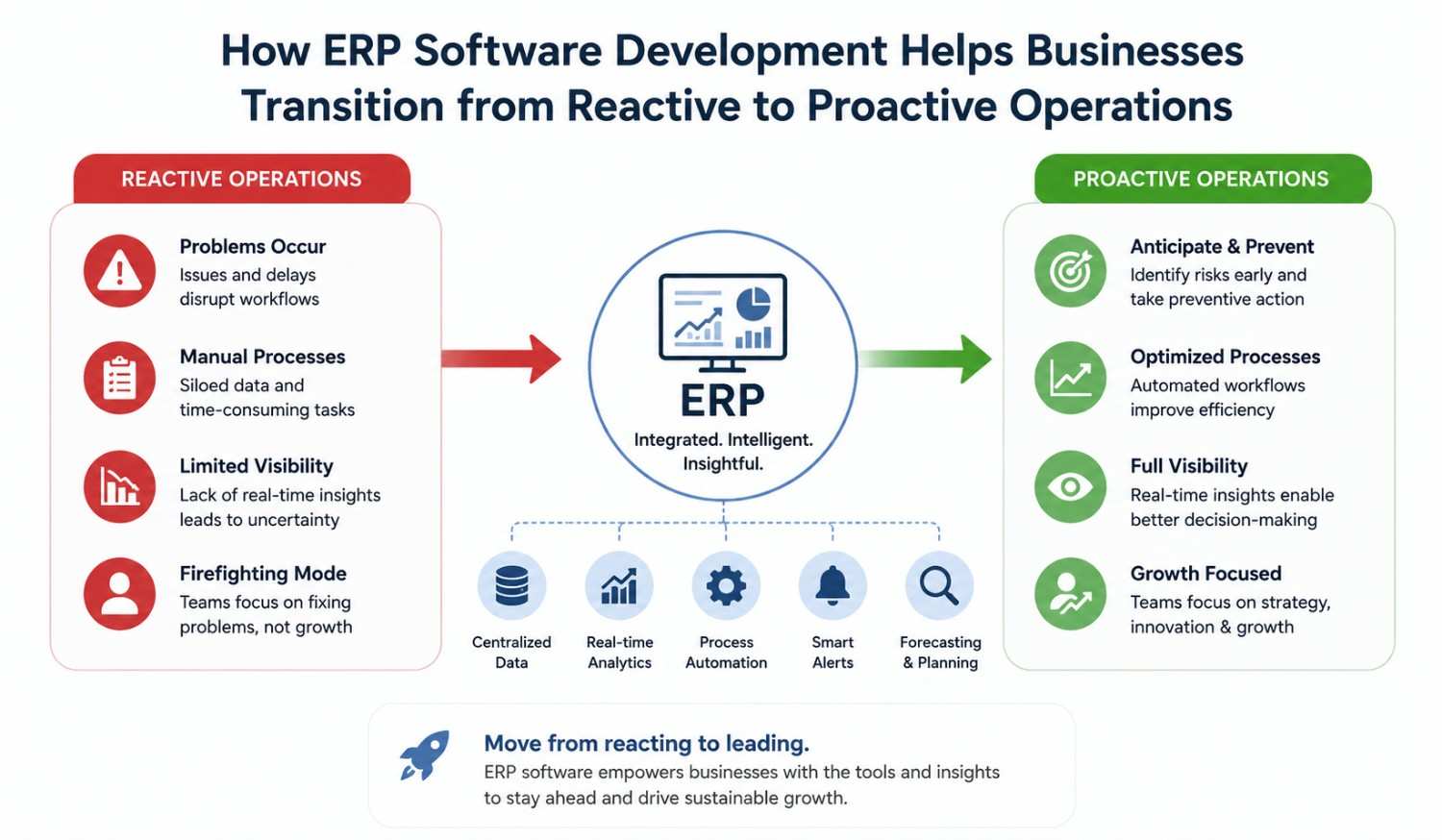
Many businesses spend their days responding to urgent emails, inventory shortages, delayed approvals, and customer complaints instead of preventing them in the first place. That approach may keep operations moving, but it rarely supports long-term growth. We believe technology should help businesses stay one step ahead—not constantly play catch-up. That is where Custom ERP Development Services make a measurable difference. A well-designed ERP system connects departments, automates repetitive tasks, and provides real-time visibility, allowing organizations to anticipate challenges before they become expensive problems. The result is a business that plans confidently instead of reacting constantly.
What Does It Mean to Move from Reactive to Proactive Operations?
Reactive operations focus on solving problems after they occur, while proactive operations concentrate on preventing those issues before they disrupt the business. The difference may sound simple, yet it changes how organizations function every day. Instead of waiting for reports that arrive too late, teams receive timely information and act immediately. Managers gain better control over workflows, resources, and customer expectations. Over time, this shift creates a workplace where decisions are based on facts rather than assumptions, making every department more efficient and better prepared for future opportunities.
Why Do Traditional Business Processes Keep Companies in Firefighting Mode?
Many organizations still depend on disconnected spreadsheets, manual approvals, paper records, and isolated software applications. These systems rarely communicate with one another, creating information gaps that slow decision-making. Employees often spend valuable hours searching for data instead of acting on it. Sound familiar? It usually does. Every delayed update increases the likelihood of mistakes, duplicated work, and missed opportunities. Eventually, businesses become experts at solving yesterday’s problems while tomorrow quietly introduces new ones. Without centralized information, continuous firefighting becomes part of the daily routine rather than the exception.
How Does ERP Software Deliver Real-Time Business Visibility?
An ERP system centralizes information from finance, sales, inventory, purchasing, production, and customer service into a single platform. Decision-makers no longer wait for multiple reports or manually combine data from different departments. Instead, they access dashboards that display current business performance whenever needed. Real-time visibility makes it easier to identify trends, monitor productivity, and respond before minor issues become major disruptions. Better information naturally leads to better decisions, helping businesses allocate resources wisely and maintain greater operational control across the entire organization.
Can ERP Automation Prevent Problems Before They Happen?
Automation removes many repetitive tasks that often lead to delays and human error. Purchase approvals, invoice processing, inventory updates, employee notifications, and recurring reports can all operate automatically through well-designed ERP workflows. Instead of relying on users to remember every task, the system performs routine actions consistently and alerts users when attention is required. We often compare automation to an exceptionally organized colleague who never forgets deadlines or coffee breaks—although it usually requires fewer reminders. Consistent automation allows businesses to focus on strategic planning rather than administrative work.
How Does Predictive Analytics Help Businesses Stay Ahead?
Predictive analytics transforms historical business information into practical guidance for future decisions. By analyzing customer demand, purchasing patterns, seasonal fluctuations, and operational performance, ERP software helps organizations forecast upcoming needs with greater confidence. Managers can prepare inventory before demand increases, adjust staffing levels during busy periods, and identify financial risks earlier. Rather than making decisions based solely on instinct, businesses rely on meaningful data that supports long-term planning. This forward-looking approach reduces uncertainty while improving operational efficiency and customer satisfaction at the same time.
Why Is Cross-Department Collaboration Essential for Proactive Operations?
Departments rarely operate independently, even when their software does. Sales depends on inventory, finance relies on purchasing, customer service requires accurate order information, and management needs visibility across every function. ERP software connects these departments through shared data, eliminating unnecessary communication delays and reducing misunderstandings. Teams work from the same information instead of multiple versions of the truth, making collaboration significantly more effective. When everyone understands current business conditions, organizations respond faster, coordinate better, and solve potential challenges before they spread across multiple departments.
How Can ERP Improve Inventory and Supply Chain Planning?
Inventory management becomes significantly more accurate when businesses have access to real-time information. ERP software monitors stock levels, supplier performance, purchase orders, and customer demand simultaneously. Automated replenishment helps avoid shortages, while demand forecasting minimizes unnecessary overstocking. Supply chain managers gain better visibility into vendor timelines, allowing them to address delays before production schedules are affected. Improved planning reduces operational costs while increasing customer satisfaction through reliable product availability. Instead of reacting to inventory emergencies, businesses manage resources with greater confidence and long-term stability.
What Role Does AI and Automation Play in Modern ERP Systems?
Artificial intelligence has expanded ERP software from a record-keeping platform into a decision-support system. AI can identify unusual purchasing patterns, predict maintenance requirements, recommend inventory adjustments, and generate business insights far faster than manual analysis. Combined with workflow automation, these capabilities reduce repetitive work while improving accuracy across departments. Instead of reviewing hundreds of reports, managers receive intelligent recommendations that deserve immediate attention. Technology does not replace experienced professionals—it simply gives them better information to make faster and more confident business decisions.
How Does Custom ERP Adapt to Unique Business Workflows?
No two businesses follow identical processes, which is why one-size-fits-all software often creates unnecessary compromises. Custom ERP solutions are designed around existing workflows, business objectives, compliance requirements, and industry-specific operations. Whether managing manufacturing, healthcare, logistics, retail, or professional services, customized modules provide flexibility without forcing employees to change proven processes. Businesses planning long-term digital transformation often choose to hire ERP developers who understand both technology and operational strategy. The result is software that grows alongside the organization rather than limiting future expansion.
Can ERP Help Businesses Respond Faster to Market Changes?
Markets rarely remain predictable for long. Customer expectations evolve, supply chains experience disruptions, and regulations continue to change across industries. ERP software provides businesses with current operational data, allowing leaders to adjust pricing, inventory, staffing, and production plans before small changes become significant challenges. Faster access to accurate information reduces uncertainty during periods of rapid change. Organizations become more agile because decisions rely on real-time business intelligence instead of outdated reports. This responsiveness creates a stronger competitive advantage in constantly changing markets.
Common Signs Your Business Needs a Proactive ERP System
Several warning signs indicate that existing systems may no longer support business growth. Frequent data duplication, delayed financial reporting, inventory inaccuracies, disconnected departments, and manual approval processes often point toward larger operational inefficiencies. Businesses may also notice declining productivity despite increasing workloads. Another common indicator is spending more time correcting mistakes than planning improvements. If management meetings focus primarily on solving recurring problems instead of discussing future opportunities, it may be time to modernize operations with a more proactive ERP approach.
Best Practices for Successfully Transitioning to a Proactive ERP Environment
Successful ERP implementation begins long before software development starts. Businesses should evaluate current workflows, identify operational bottlenecks, and establish measurable objectives for improvement. Employee involvement throughout planning and implementation increases user adoption while reducing resistance to change. Training should continue after deployment to help teams fully utilize new capabilities. Regular performance reviews and system updates ensure the ERP solution continues supporting evolving business requirements. Digital transformation is not a one-time project—it is an ongoing process of continuous improvement and operational excellence.
Why Choosing the Right ERP Development Partner Matters
Technology alone cannot transform a business without thoughtful planning and experienced implementation. A reliable ERP development partner understands industry challenges, operational workflows, integration requirements, and long-term scalability. Beyond writing code, the right team evaluates business goals and recommends solutions that deliver measurable value. Organizations investing in ERP should look for technical expertise, transparent communication, ongoing support, and proven project experience. The strongest partnerships focus on solving business challenges—not simply delivering software—and that approach often determines the project’s long-term success.
Conclusion
Transitioning from reactive operations to proactive management is no longer a competitive advantage—it has become a business necessity. Organizations that rely on disconnected systems often spend valuable time responding to problems instead of preventing them. Modern ERP software changes that equation by combining automation, real-time visibility, predictive analytics, and connected workflows into one intelligent platform. We have seen businesses replace uncertainty with confidence simply by making information available when it matters most. Investing in the right ERP solution today creates a stronger, smarter, and more resilient business prepared for tomorrow’s opportunities instead of yesterday’s challenges.
Frequently Asked Questions (FAQs)
1. What is proactive ERP software?
Proactive ERP software helps businesses identify trends, automate routine processes, and monitor operations in real time. Instead of responding after issues occur, organizations receive timely insights that support preventive actions and smarter planning.
2. How does ERP improve business decision-making?
ERP centralizes business information from multiple departments into one platform. Decision-makers gain access to accurate, real-time reports that improve forecasting, budgeting, inventory planning, and overall operational efficiency.
3. Why should businesses choose Custom ERP Development Services instead of off-the-shelf ERP?
Custom ERP Development Services allow businesses to build software around their unique workflows instead of changing processes to fit standard applications. This flexibility improves productivity, scalability, and long-term return on investment.
4. Can ERP software reduce operational costs?
Yes. ERP reduces manual work, minimizes errors, automates repetitive tasks, improves inventory management, and streamlines business processes, helping organizations lower operational expenses while increasing productivity.
5. How long does ERP software development usually take?
Development timelines depend on project complexity, required modules, integrations, and customization. Small ERP projects may take several months, while enterprise-level implementations can require additional planning and phased deployment.
6. Is ERP suitable for small and medium-sized businesses?
Absolutely. Modern ERP solutions are scalable and can be designed to match the needs of growing businesses. Companies can begin with essential modules and expand functionality as operations evolve.
7. How does ERP improve supply chain management?
ERP provides real-time inventory tracking, supplier management, demand forecasting, automated purchasing, and logistics visibility. These capabilities improve planning, reduce shortages, and enhance overall supply chain efficiency.
8. When should businesses hire ERP developers for custom solutions?
Businesses should hire ERP developers when existing software no longer supports operational growth, requires extensive manual work, or cannot adapt to unique business processes. Experienced developers can design scalable ERP solutions that align with current requirements while supporting future expansion.


 Irshad sultan