
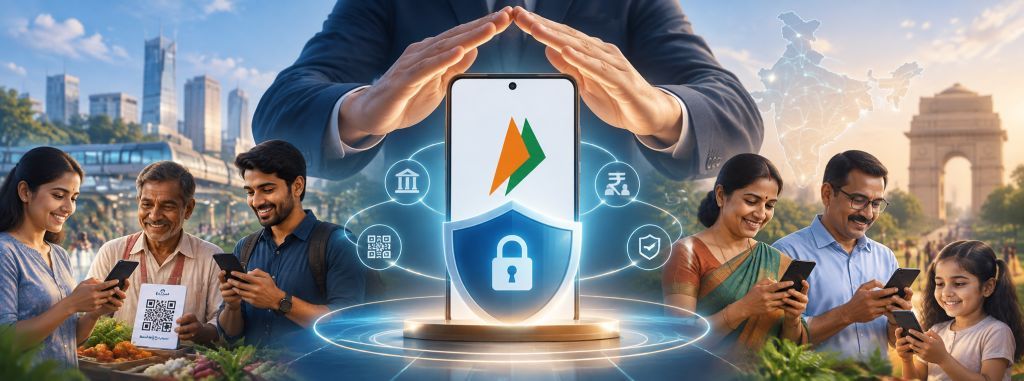
India's UPI revolution was built around an idea that was remarkably simple: digital payments should be instant, interoperable and free for consumers.
That combination did more than introduce a new payment technology. It changed everyday behaviour.
A vegetable seller, taxi driver, neighbourhood store and major retailer could all accept payments digitally without worrying about whether customers were carrying enough cash. For the customer, the process was equally straightforward: scan the QR code, make the payment and move on.
No cash. No searching for change. No waiting.
That convenience turned UPI from another payment method into an everyday habit.
The proposed introduction of a Merchant Discount Rate (MDR) on higher-value UPI transactions therefore raises an important policy question. Even if consumers are not directly charged, adding a cost to the system could eventually affect what happens between merchants and customers.
The Cost May Not Stay With Merchants
Merchants ultimately bear the cost of accepting payments through payment networks. If accepting a UPI payment becomes more expensive, businesses will naturally consider how to recover that additional expense.
Some could increase prices. Others might provide incentives for cash payments. Some may encourage customers to divide larger transactions into smaller ones, while others could simply prefer cash for high-value purchases.
India has experienced similar challenges with card payments.
For years, policymakers and the financial industry encouraged consumers and businesses to move away from cash. UPI accelerated this transition by eliminating several barriers associated with traditional digital payments.
There was no card machine to operate, no physical card required and, most importantly, no obvious cost to the consumer.
That perception of zero cost has played an important role in UPI's adoption.
Why Consumer Perception Matters
Consumers do not necessarily think about payment networks, interchange economics or MDR when they make a purchase.
They think about what happens at the point of payment.
Imagine a customer making a ₹2,500 purchase. If the merchant says that cash is preferred because a UPI payment now carries an additional cost, the customer's perception of the payment method can change immediately.
India is a highly price-sensitive market. Even a relatively small additional cost can influence consumer behaviour when an alternative such as cash remains available.
The economic details of MDR may be complicated, but the customer's experience is not.
If UPI becomes associated with additional charges while cash remains free, some consumers may simply return to cash for certain transactions.
That would undermine part of the behavioural transformation UPI has achieved.
High-Value Transactions Are Particularly Important
There is another dimension to the debate.
The number of UPI transactions above ₹2,000 may represent a smaller proportion of total transactions, but those payments can account for a much larger share of the overall transaction value.
That makes higher-value payments attractive from a monetisation perspective.
At the same time, however, charging these transactions could affect a significant portion of the money moving through India's digital commerce ecosystem.
The policy challenge is therefore not simply about the number of transactions.
It is about where those transactions sit within the broader digital economy.
UPI Is More Than Another Payment Network
UPI's success came from more than simply making digital payments faster.
It created an interoperable public digital payment infrastructure on which banks, fintech companies and merchants could build competing services.
Consumers did not need to understand the underlying architecture.
They only needed to know that it worked.
That simplicity is one of UPI's most important achievements.
Once a system becomes part of everyday behaviour, people stop thinking about the technology behind it. Paying through UPI becomes as routine as handing over cash.
That is precisely why any change to its cost structure needs to be considered carefully.
The Case for MDR Is Understandable
There is a legitimate economic argument for introducing MDR.
Running a payment ecosystem is not free. Banks, payment companies and technology providers have expenses related to infrastructure, cybersecurity, fraud prevention, regulatory compliance, customer service and maintaining the systems required to process enormous transaction volumes.
As UPI continues to scale, those costs cannot simply disappear.
A sustainable payment ecosystem needs a sustainable economic model.
The question, therefore, is not whether UPI is technically capable of supporting MDR.
It is.
The more important question is whether the additional revenue generated by such a charge justifies the possibility of changing how merchants and consumers perceive and use UPI.
UPI Should Not Become Another Card Network
UPI's success was partly built on the fact that consumers did not have to think about payment costs every time they used it.
If charges become visible at the point of payment, UPI could increasingly be compared with cash on the basis of price rather than convenience.
That would change the equation.
Today, a merchant can accept a UPI payment because it is convenient for both sides. If the merchant starts viewing cash as the cheaper option, the customer may encounter a different experience at the counter.
A payment system that has spent years encouraging people to move from cash to digital payments should be careful about creating incentives that move behaviour in the opposite direction.
Finding a Better Way to Monetise the Ecosystem
None of this means the UPI ecosystem should remain financially static forever.
The infrastructure will continue to evolve, and its participants need sustainable ways to recover their costs.
But there is an important distinction between monetising the UPI ecosystem and placing a visible cost at the point where consumers and merchants use UPI.
Policymakers could therefore explore models that support banks, payment providers and other ecosystem participants without weakening the consumer's perception that UPI is a simple and frictionless way to pay.
The revenue model can change.
The technology can evolve.
The infrastructure can become more sophisticated.
But the fundamental user experience deserves careful protection.
Protecting the Habit India Has Built
India spent years developing the habit of digital payments.
UPI helped reduce reliance on physical cash, made transactions easier and created digital payment access for businesses of vastly different sizes.
Those gains did not happen automatically. They came from creating a system that was convenient enough for people to use repeatedly.
That habit is arguably one of UPI's most important achievements.
The lesson is therefore straightforward: any policy change should consider not only the financial economics of UPI but also its behavioural economics.
A payment system can be technically sustainable and still lose some of its appeal if users begin associating it with additional costs.
UPI did not become a global digital-payment success merely because it processed transactions quickly. It succeeded because it made digital payments feel effortless.
The architecture can evolve. The business model can evolve. New sources of revenue can be explored.
But the core proposition that made millions of Indians comfortable with digital payments should not be weakened without careful consideration.
UPI's biggest achievement was changing how India pays. Protecting that behavioural shift should remain central to any discussion about its future.