
As policymakers and technology leaders gather at Bharat Mandapam for the India AI Impact Summit 2026, much of the discussion is understandably focused on sectors where Artificial Intelligence could deliver immediate developmental benefits, including healthcare diagnostics, agricultural productivity, educational access and climate resilience.
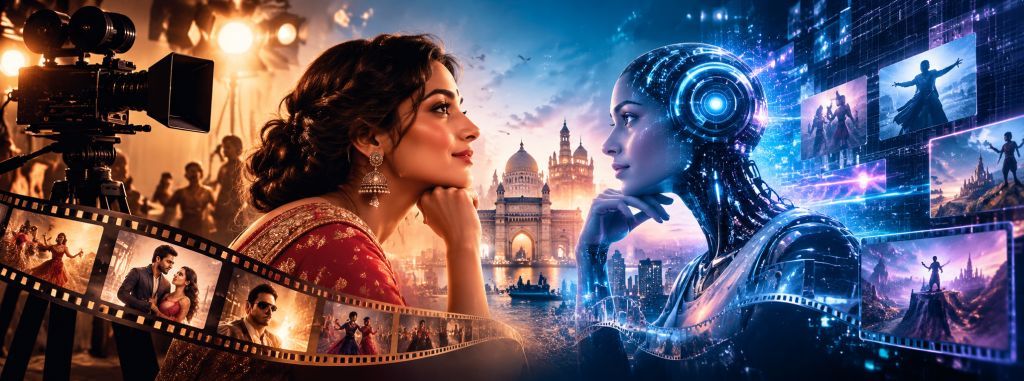
Yet within this broad vision of AI-driven transformation, one sector remains relatively underrepresented: Media and Entertainment.
That omission is notable, not because cinema should take precedence over healthcare or education, but because the creative economy sits at the intersection of technology, employment, exports and national influence.
If AI is going to transform how societies work, learn and govern, it will also influence how they imagine themselves, tell stories and present their identity to the world.
India's Media and Entertainment Opportunity
India's Media and Entertainment sector is currently estimated at around $28-30 billion, with continued growth expected as digital consumption and streaming expand.
The sector directly employs millions of people, including actors, cinematographers, editors, musicians and technicians. It also supports many more indirectly through advertising, tourism, event management, logistics and hospitality.
India also produces more films each year than any other country, often exceeding 1,500 films across multiple languages. That reflects a scale of cultural production that remains unmatched globally in terms of volume.
But size alone does not necessarily translate into structural strength.
India's film ecosystem has traditionally operated with narrow margins, unpredictable financing structures and uneven adoption of technology. Production can take considerable time, marketing decisions are often driven by intuition and international monetisation remains inconsistent.
The industry's creative energy has never been in doubt.
Its efficiency is another matter.
AI as a Systemic Change
Artificial Intelligence enters this environment as more than an additional production tool.
It has the potential to affect the filmmaking process from beginning to end.
The earliest stage is the creation of an idea.
Historically, evaluating scripts has depended heavily on experience and instinct. AI-based analytical systems can now examine elements such as narrative structure, pacing, themes, genre compatibility and potential audience engagement.
These tools do not eliminate creative judgement.
Instead, they can reduce information gaps.
In an industry where one poorly judged project can create financial pressure across an entire production chain, better risk assessment can have significant economic value.
Transforming Pre-Production
AI-powered pre-visualisation and generative modelling can also change the way films are designed before cameras begin rolling.
Filmmakers can digitally simulate sets, experiment with shot compositions and optimise production schedules before committing to physical production.
Tasks that previously required expensive physical prototypes can be tested and refined digitally.
Even relatively small improvements in efficiency, when multiplied across hundreds of productions, can translate into meaningful savings.
Post-Production and Greater Output
Post-production has traditionally been one of the more time-consuming stages of filmmaking.
AI-assisted editing, colour grading, sound enhancement and visual augmentation could further compress production timelines.
When production speed increases without a corresponding rise in costs, the industry gains greater output flexibility.
More stories can potentially be produced within the same financial limits.
That could have particular significance for an industry operating across so many languages and production centres.
Language Could Become India's Biggest Advantage
Perhaps the most significant opportunity for India lies in language.
The country has 22 constitutionally recognised languages along with hundreds of dialects.
This linguistic diversity is one of India's greatest cultural strengths, but it has also historically created challenges for distribution.
AI-powered dubbing, voice synthesis and real-time lip-sync correction can reduce those barriers.
A film created in one linguistic region could potentially reach audiences elsewhere in India and abroad more quickly and with greater consistency.
In an increasingly digital marketplace, where recommendation systems increasingly influence what audiences discover rather than relying exclusively on physical theatre screens, the ability to adapt content across languages becomes strategically important.
OTT and the Algorithmic Audience
The expansion of OTT platforms adds another dimension to this transformation.
India has one of the world's largest internet-user populations, while streaming revenues are expected to continue growing.
Algorithms increasingly influence what audiences watch and, in turn, what producers choose to commission.
This creates feedback loops between viewer behaviour and creative decisions.
In such an environment, AI does not merely determine how cinema is distributed.
It can increasingly influence how cinema itself develops.
Why Policymakers Should Pay Attention
The implications extend beyond filmmaking.
Creative industries are labour-intensive and heavily youth-driven. They contribute to employment clusters in cities, export earnings and India's cultural influence abroad.
Cinema and entertainment also shape how India is perceived internationally.
Their influence on global perceptions can therefore be significant, much like other forms of international outreach.
If AI adoption were to improve productivity even modestly, such as by 10 percent across production processes, the cumulative effect across thousands of annual projects could be substantial.
Lowering the Barrier to Entry
AI could also make advanced production capabilities more accessible.
Smaller studios could gain access to tools that were previously affordable only to major production houses and large conglomerates.
Independent creators could experiment with ambitious concepts without needing the same level of physical infrastructure.
This could broaden participation in India's creative economy.
Greater access to production capabilities can, in turn, strengthen cultural plurality.
Adoption Must Be Structured
However, wider AI adoption also presents challenges.
Without frameworks for skills transition, automation could affect vulnerable sections of the workforce.
Without clear intellectual property protections, generative technologies could create uncertainty around ownership and rights.
And without sustainable energy planning, the computational demands associated with AI could conflict with environmental commitments.
These concerns do not necessarily argue against adopting AI.
They point instead toward the need for a structured approach to adoption.
Bringing Entertainment Into the AI Conversation
If the India AI Impact Summit aims to define how artificial intelligence can contribute to equitable growth, Media and Entertainment should not remain outside the central discussion.
Storytelling is not simply decorative.
It influences aspiration, identity and national confidence.
As technology becomes increasingly embedded in everyday life, cultural production will also become more technologically mediated, much like healthcare diagnostics and financial services.
India's film industry already has enormous scale, linguistic diversity and strong connections with the global Indian diaspora.
AI could add another layer to that foundation by improving efficiency, strengthening predictive analysis and making content easier to adapt across languages.
The Choice Ahead
The question is therefore not whether AI will change cinema.
It is whether cinema will be deliberately incorporated into India's broader AI strategy or whether the sector will be left to adapt unevenly under market forces alone.
If the creative economy is intentionally included in the country's AI transformation, India's Media and Entertainment sector could become one of the most dynamic beneficiaries of the country's AI-driven future.