
Keralites are often regarded as some of India's most educated people. They read newspapers, argue about politics, discuss literature and speak confidently about international affairs, at least according to the stereotype many North Indians encounter.
Yet when alcohol enters the picture, that reputation for sophistication can sometimes seem to disappear as quickly as a peg of rum on a rainy evening.
Of course, not every Keralite drinks, and drinking does not automatically mean behaving badly. But anyone who has spent time in rural Kerala will recognise that alcohol has its own traditions, rituals, stories and folklore.
For many drinkers, it is less about slowly enjoying a beverage and more about completing a mission. The goal can seem to be finishing one drink before the next round arrives.
A "small peg" can become something resembling an emergency procedure: pour, lift, swallow, grimace, breathe out and repeat.
The expression after the final gulp is often unforgettable, combining satisfaction, discomfort and something resembling a moment of spiritual discovery.
I was always the exception.
Thirty millilitres could easily last me three hours. The drink itself was never the main attraction. I preferred the conversation, jokes and banter happening around the table.
Staying relatively sober had one considerable advantage: I could watch everyone else's performance from the front row.
That is probably why I remember these stories while many of the people involved do not.
The Real Drinking Culture Lives in Toddy Shops
For genuine connoisseurs, ordinary bars were merely the beginning.
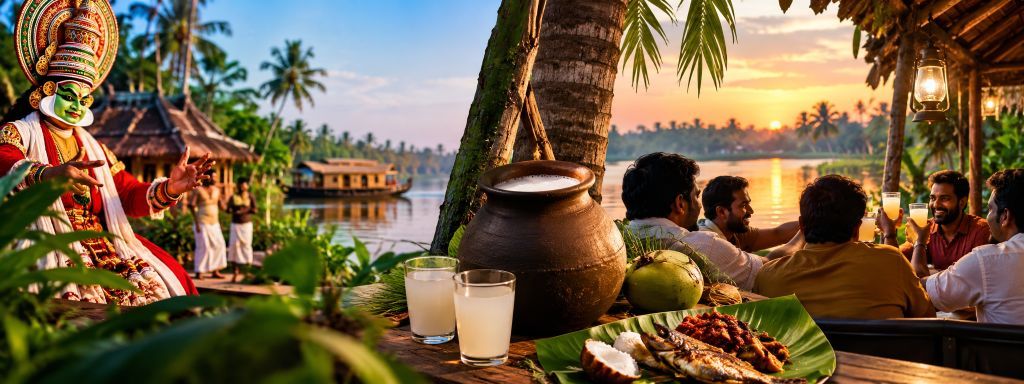
The heart of Kerala's traditional drinking culture could be found in toddy shops.
Toddy, or kallu, begins its journey high above the ground.
Before dawn, a toddy tapper climbs a coconut or palmyra palm carrying little more than a knife, a rope and years of experience.
The flower stalk is carefully cut and gently beaten over several days to encourage the sap to flow. A clay pot is then positioned beneath the cut, allowing the sap to collect slowly through the night.
By morning, the natural fermentation process has already begun. The freshly collected toddy is mildly sweet, but after several hours it develops a much stronger character.
Traditionally, toddy tapping in Kerala was a hereditary occupation associated with particular communities and sub-castes.
Even if the palm trees were growing on your own property, you could not simply climb the tree and collect the sap yourself. The specialised tappers were called to do the job.
They would receive their share, while the remaining toddy entered a system involving cooperatives and licensed toddy shops before eventually reaching customers across the state.
It was demanding work that required skill, balance and considerable courage.
The men climbed tall palms with little more than ropes around their waists and ankles. A single mistake could have deadly consequences.
A Childhood Memory
I remember one such tragedy from my childhood.
A toddy tapper working on my grandfather's property fell from a palm and died.
For months afterward, my grandfather had to travel around 60 kilometres to attend court proceedings before the matter was eventually resolved.
That experience taught me something I had never considered before.
Behind every glass of toddy was an entire chain of labour, tradition, danger and responsibility.
The drink that eventually appeared on a table had a much longer story behind it.
Even the Insects Join the Party
Fermentation also has its unintended visitors.
Bees, flies, beetles and occasionally an overly enthusiastic bumblebee are attracted to the smell.
Some cannot resist the temptation and end up falling into the pot, meeting an unexpectedly pleasant but unfortunate end.
Nobody appears particularly concerned.
The toddy gets strained, the conversation continues, the fish fry arrives and life carries on.
To an outsider, the scene might sound disturbing.
To regular customers, it is simply another part of the experience.
One could even joke that the insects have excellent taste.
More Than Just a Place to Drink
The drink itself was never really the whole attraction of a toddy shop.
The atmosphere mattered just as much.
There were long wooden benches, often sticky after years of spilled kallu and repeatedly wiped down with old newspapers.
Then came the food.
Freshly fried pearl spot fish.
Spicy duck roast.
Kappa and meen curry, or tapioca served with fish curry.
And, traditionally, very little concern about accommodating vegetarians.
A Kerala toddy shop was therefore much more than a place to consume alcohol.
It was a community gathering place where fermented drinks happened to be served alongside food and conversation.
My Uncle and His Famous Lungi
Then there was my uncle.
Whenever a photograph was being taken, he had a particular style. A couple of shirt buttons would be left open to reveal his impressively hairy chest, accompanied by a thick fake-gold chain.
That was his photographic uniform.
On ordinary days, however, like many rustic Keralites of his generation, he rarely bothered with a shirt.
A lungi was considered sufficient for almost every activity.
The real problem came when it was time to return home after drinking.
The Journey Home
Getting home from a night out was already an adventure.
The journey involved taking a bus from a nearby town roughly ten kilometres away, walking another two kilometres, crossing a narrow stream using a bridge made from a single coconut-tree trunk and then making one's way across a paddy field.
The problem was that my uncle was often too drunk to successfully complete this obstacle course.
On several occasions, search parties had to be organised.
People would carry flaming coconut-frond torches while searching the surrounding area.
Eventually, they would find him peacefully asleep in a paddy field, snoring beneath the night sky.
And even reaching home did not necessarily mean the adventure was over.
There were occasions when he had somehow lost his lungi somewhere along the route and arrived home wearing nothing but his underwear.
The following morning, someone would have to retrace his journey and locate the missing garment.
The Last Bus Matters
I once noticed another example of Kerala's unique drinking logistics in a bar in Kothamangalam.
A man kept stepping outside every few minutes.
Eventually, I asked him what was wrong.
He looked genuinely concerned.
"The last bus to my village leaves at 8:30 PM," he explained. "If I miss it, I'm stuck here."
That was when I realised that drinking required a certain level of planning.
You had to remain sober enough to calculate when the final drink should be ordered.
The timing had to work.
Miss the bus, and the entire plan collapsed.
A Unique Kind of Logistics
In many parts of Kerala, drinking has historically involved much more than deciding what to order.
You had to know how far away the bar was.
You had to remember the time of the last bus.
You had to know whether you could still cross a narrow coconut-tree bridge.
And, perhaps most importantly, you needed to remember where you had left your lungi.
That may be one of the most uniquely Kerala aspects of the entire experience.
But looking back, the alcohol itself was never really the most memorable part.
The stories were.
The search parties.
The missed buses.
The disappearing lungis.
The impossible journeys home.
And the next morning's attempt to reconstruct exactly what had happened.
"What happened after we left the bar?"
Nobody was ever completely certain.
But somebody always had a theory.
The alcohol disappeared by morning.
The stories, however, continued fermenting for a lifetime.