Compare Your Fare Across Airlines and Find Affordable Flights

Finding an affordable flight rarely comes down to luck. More often, it comes down to how much effort you put into research before hitting “book.” With airline pricing changing constantly and every carrier structuring fees differently, the smartest move any traveler can make is to compare your fare across multiple airlines rather than settling on the first price that pops up.

This isn’t about chasing the absolute cheapest ticket every time — it’s about understanding your options well enough to make an informed choice. This guide walks through the practical steps involved in comparing fares, what factors actually affect the total cost of a trip, and how to approach flight shopping without falling for false promises of “guaranteed lowest prices.”

Why It Pays to Compare Your Fare Before Booking

Every airline has a different pricing strategy on the same route on the same day. What you are quoted is affected by factors like fuel costs, competition, seat demand, and booking class. That means you could pay a very different price for the same trip, depending on the airline and fare type you choose.

When you shop your fare among multiple carriers, you can be more sure of:

  • How the base ticket price compares to the competition
  • What is really covered in each fare (baggage, seat choice, changes)
  • if a slightly higher fare could be better value overall
  • Which routes or days are generally cheaper

There is no one search that will guaranty the lowest possible price – pricing is too dynamic for that – but consistently comparing fares gives you a realistic sense of what a fair price looks like for your trip.

Start by Comparing Fares Across Multiple Airlines

It’s tempting to stick with a favorite airline out of habit or loyalty but you could be missing out on better options elsewhere. Different carriers compete on different routes, and a budget airline may undercut a major carrier by a large margin on one route but offer no advantage at all on another route.

How to Approach Multi-Airline Comparison

  1. Search several airlines individually, especially budget carriers that sometimes don’t appear on all comparison platforms.
  2. Use a flight comparison tool to view multiple airlines side by side without opening dozens of tabs.
  3. Check both legacy carriers and low-cost airlines, since their pricing structures and included amenities differ substantially.

This is where a platform like FareCompare can be genuinely useful — it pulls together pricing from various airlines in one place, saving time when you want to compare your fare options without manually checking each airline’s website. That said, it’s still worth spot-checking an airline’s own site occasionally, since fares and availability can shift or differ slightly between sources.

Be Flexible With Your Travel Dates

Ticket prices can swing considerably based on the specific day you fly. Airlines adjust pricing based on demand patterns, and even shifting your trip by a day or two can lead to a noticeably different fare.

Practical Tips for Date Flexibility

  • Check a date range, not just one day. Many search tools offer a calendar view showing price differences across a week or month.
  • Consider midweek travel. Tuesdays and Wednesdays are often less in-demand than Fridays and Sundays.
  • Look at shoulder-season travel. Traveling just outside peak season can mean lower fares with only a modest difference in weather or crowds.
  • Avoid assuming there’s a universal “cheapest day to book.” Despite popular myths, pricing patterns vary by route, airline, and season — there’s no single rule that applies everywhere.

If your travel dates are flexible, use that flexibility. It’s one of the most reliable ways to reduce cost, even more than promotional sales or last-minute discounts.

Consider Alternative Airports

Many travelers automatically search flights from their nearest major airport, but that’s not always the most economical choice. Secondary or regional airports often have lower landing fees for airlines, which can translate into cheaper fares for passengers.

What to Weigh When Comparing Airports

  • The fare difference between your primary and alternative airport options
  • Transportation costs and time required to reach a farther airport
  • Parking fees if you’re driving, especially for longer trips
  • Flight frequency and schedule convenience at each airport

Example: A traveler flying from a large metro area might find that a regional airport an hour away offers fares $50–$100 cheaper than the closer international hub. After factoring in gas or a rideshare cost, it can still work out to meaningful savings, particularly for longer trips.

Factor in Baggage and Add-On Costs

A low base fare doesn’t always mean a low total cost. Baggage fees, seat selection charges, and other add-ons can add up quickly, especially with budget airlines that unbundle nearly every service.

Questions to Ask Before Booking

  • Does the fare include a carry-on bag, or only a personal item?
  • What does a checked bag cost, and does that price increase if paid at the airport instead of online?
  • Are seat assignments free, or is there an extra charge even for standard economy seats?

When you compare your fare across airlines, it’s worth calculating the total estimated cost — base fare plus baggage and any other fees you’re likely to pay — rather than comparing sticker prices alone. A $220 fare that includes a checked bag may end up cheaper than a $180 fare that charges $50 for the same bag.

Nonstop vs. Connecting Flights

One of the more significant decisions when comparing flights is whether to prioritize a nonstop route or accept a layover for a lower price.

Nonstop Flights

Pros:

  • Shorter total travel time
  • Lower risk of missed connections
  • Less exposure to delays caused by a second flight

Cons:

  • Often priced higher, especially on popular routes
  • Fewer schedule options on some routes

Connecting Flights

Pros:

  • Frequently cheaper than nonstop alternatives
  • More flexible departure and arrival time options
  • Sometimes the only available option on less common routes

Cons:

  • Longer overall travel time
  • Increased risk of delays affecting your connection
  • Possible additional costs if an overnight layover requires a hotel stay

There’s no universally “better” choice — it depends on how much you value time versus cost. A short layover with a reasonable connection window can offer solid savings without excessive risk, while red-eye connections or very tight layovers may not be worth the trade-off for some travelers.

Other Factors Worth Comparing

Beyond price, dates, airports, and layovers, a few additional details can shape your decision:

  • Cancellation and change policies: Some fares are non-refundable or charge steep change fees, while others offer more flexibility.
  • Loyalty program considerations: If you fly a particular airline often, miles or status benefits might factor into your decision even if the fare isn’t the absolute lowest.
  • On-time performance: Airlines vary in reliability, which can matter more than a small price difference, especially for connecting itineraries.
  • In-flight experience: Seat pitch, Wi-Fi availability, and meal service differ across carriers and fare classes.

A Realistic Approach to Fare Comparison

Let’s be clear: there’s no tool or technique that will guaranty you’ll find the lowest price every single time. Prices can vary based on demand, seat availability and airline algorithms that are not entirely predictable. But what a comparison does give you is a better informed starting point – a way to see what your realistic options are, instead of booking blind.

I think you get better results with a tool like FareCompare and some manual legwork (check a couple of airline sites directly, try a few date ranges, factor in nearby airports) than you do with one search.

Frequently Asked Questions

How many airlines should I check before booking?

There’s no magic number, but comparing at least three to five airlines, a mix of legacy and budget carriers, will generally give you a decent idea of pricing for your route.

Does booking through a comparison site cost more than booking directly?

Not very often. Comparison tools tend to show the same base fare as the airlines but it’s always good to check the final price, including fees, before purchasing.

Is it better to book far in advance or wait for a last-minute deal?

If you book too early or too late, prices are higher. Most routes are likely to have more consistent reasonable prices if you book a few weeks to a couple of months ahead rather than waiting until the last minute.

Are connecting flights always cheaper than nonstop flights?

often, tho not always. If just one airline has a monopoly on a route , nonstop flights can be priced competitively , at least on some routes . Both are worth comparing instead of assuming one is automatically cheaper.

Can I trust a comparison site to show every available fare?

Most comparison platforms have a wide range of airlines, but not all budget carriers are available on every third party tool. It’s also worth checking a couple of airline websites directly.

Final Thoughts

There’s no one clever trick to finding an affordable flight, it’s about consistently comparing your options across airlines, dates, airports and fare types. If you’re comparing fares thoughtfully — taking into account baggage costs, layovers and cancelation policies as well as the base price — you get a much clearer sense of what you’re actually paying for.

Tools like FareCompare can help make the research easier by pulling multiple airlines into one view, but there’s no substitute for a little manual diligence and flexibility with your plans. Build the habit of checking fares over time instead of doing a one-time search and you’ll be in a better position to find flights that meet both your budget and your travel needs.

Related Posts

Best Taxi from Gatwick Airport to SE1 Southwark

Travelling from Gatwick Airport to SE1 Southwark is a common route for tourists, business travellers, families, and international visitors arriving in London. After a long flight, finding comfortable and reliable…

How to Find Low Cost Umrah Packages

Planning Umrah on a limited budget requires more than choosing the cheapest advertised price. Pilgrims should compare flights, hotels, visa services, transport, travel dates, and package inclusions before booking. The…

Leave a Reply

Your email address will not be published. Required fields are marked *

You Missed

What Are Cross Training Shoes and Why Do You Need Them?

What Are Cross Training Shoes and Why Do You Need Them?

Compare Your Fare Across Airlines and Find Affordable Flights

Compare Your Fare Across Airlines and Find Affordable Flights

California Cannabis Delivery: Convenience, Selection, and What to Know

Окна в Москве после установки: пять фраз, которые лучше не произносить через месяц

Окна в Москве после установки: пять фраз, которые лучше не произносить через месяц

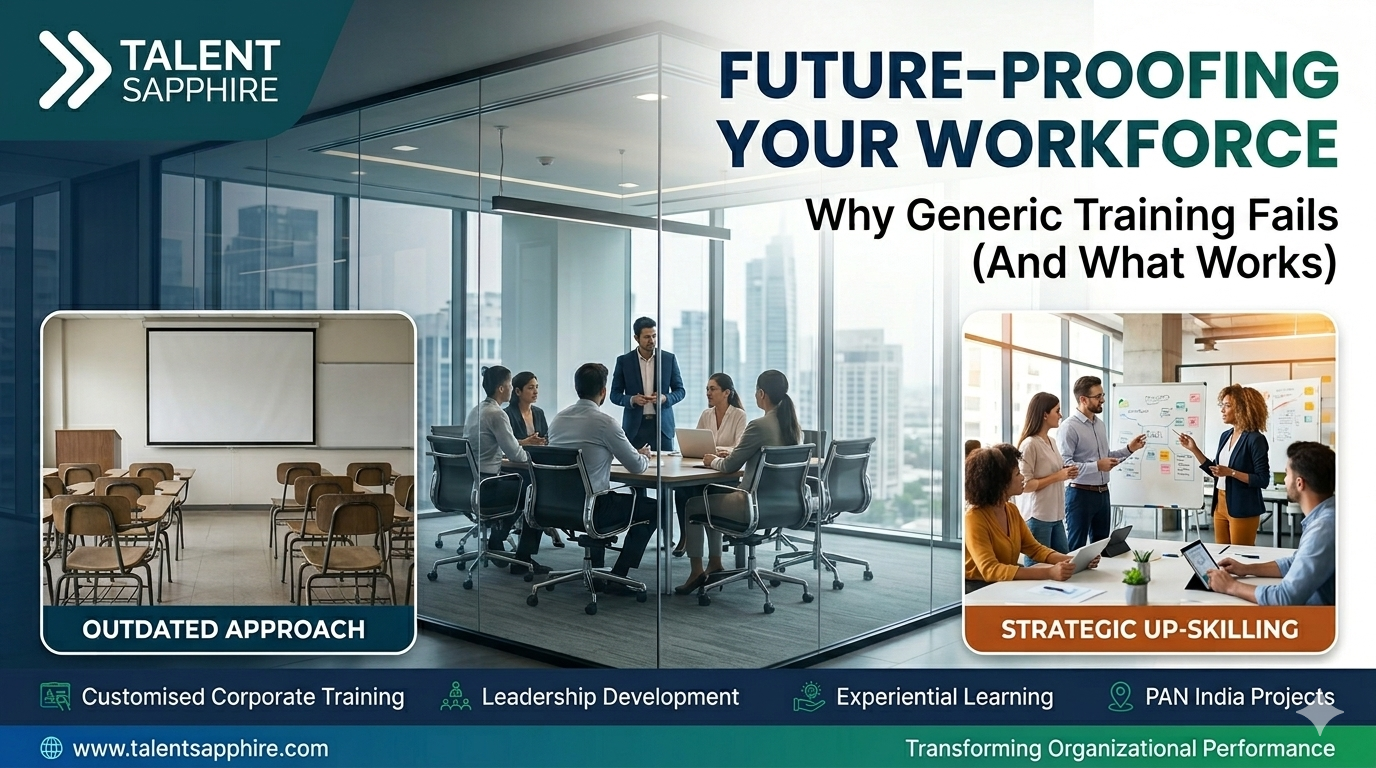
The modern corporate landscape is moving faster than ever. Between the rapid adoption of automation, shifting workplace values across generations, and the constant demand for operational efficiency, human resource leaders face a critical challenge: How do you build a workforce that doesn’t just keep up, but actively drives market growth? Many organizations pour significant portions of their annual budget into standard, off-the-shelf workshops. Yet, a few weeks after the session, employees often slip right back into old habits. The truth is that generic training fails because it treats unique business ecosystems with a one-size-fits-all brush. To see a genuine return on your investment, your upskilling strategy needs to be as dynamic and tailored as your business goals. Here is a look at why traditional training models are broken, and how modern organizations are restructuring their learning and development (L&D) strategies for lasting success. The Pitfall of the “One-Size-Fits-All” Workshop Every organization features its own distinct internal culture, operational pain points, and cross-functional friction. When you deploy a rigid, pre-packaged training program, it fails to address the specific day-to-day challenges your employees experience on the ground. True workforce capability development requires a partner capable of building a custom architecture. Working with a dedicated provider to engineer customised corporate training solutions ensures that every module is directly aligned with your operational priorities, industry vertical, and specific skill gaps. Bridging the Leadership Gap for First-Time Managers One of the most frequent organizational missteps is promoting an exceptional technical performer or individual contributor to a managerial role without providing a proper transition framework. Managing people requires an entirely different skill set than managing tasks. Without targeted development, new leaders often struggle with delegation, team motivation, and constructive feedback loops. Implementing a structured first-time managers training program bridges this gap early, equipping emerging leaders with the behavioral tools they need to reduce team turnover and maintain high performance. For organizations aiming to cultivate long-term strategic vision at executive levels, a comprehensive leadership development program in India ensures your leadership pipeline remains robust and future-ready. Beyond Technical Know-How: The Power of Behavioral and Soft Skills Technical expertise can get your foot in the door, but behavioral alignment and communication keep the business moving forward. From handling high-stakes client negotiations to managing workplace conflict, soft skills are the silent engine of productivity. A modern L&D strategy must treat these competencies as measurable, essential skills. Investing in professional soft skills training services and targeted corporate behavioral skills training directly impacts how your teams collaborate across departments, leading to fewer project bottlenecks and smoother execution. Activating Engagement Through Experiential Learning Sitting in a conference room staring at slide decks rarely inspires behavioral change. For teams to truly absorb organizational values and learn how to collaborate under pressure, they need to experience it. This is why forward-thinking organizations are moving toward experiential models. Utilizing structured corporate team building programs or getting teams out of the office for corporate outbound & OBT training program services places employees in dynamic, hands-on scenarios. These environments break down workplace silos, build trust, and teach real-time problem-solving far more effectively than traditional lectures. Scaling Consistency Across PAN-India Operations For enterprises with regional offices, manufacturing plants, or distributed teams across the country, maintaining a uniform standard of training is incredibly difficult. Local nuances, varying trainer quality, and logistical hurdles often lead to an fragmented learning experience. To counter this, scaling organizations require a partner with deep infrastructural reach. Partnering with an organization capable of executing PAN India training projects ensures that whether your employees are based in Delhi-NCR, Mumbai, or remote locations, they receive the exact same high standard of content delivery and facilitator expertise. The Bottom Line Training shouldn’t be a check-the-box exercise to fill an HR calendar. It is a strategic business driver. When you shift away from generic presentations and focus on customized, behavior-driven learning paths, you don’t just train your employees—you elevate your entire organizational capability. If you are looking to audit your current workforce capabilities and design a high-impact learning intervention, explore the tailored programs offered by Talent Sapphire, a premier corporate training company in India dedicated to transforming organizational performance from the ground up.

The modern corporate landscape is moving faster than ever. Between the rapid adoption of automation, shifting workplace values across generations, and the constant demand for operational efficiency, human resource leaders face a critical challenge: How do you build a workforce that doesn’t just keep up, but actively drives market growth?  Many organizations pour significant portions of their annual budget into standard, off-the-shelf workshops. Yet, a few weeks after the session, employees often slip right back into old habits.  The truth is that generic training fails because it treats unique business ecosystems with a one-size-fits-all brush. To see a genuine return on your investment, your upskilling strategy needs to be as dynamic and tailored as your business goals.  Here is a look at why traditional training models are broken, and how modern organizations are restructuring their learning and development (L&D) strategies for lasting success.  The Pitfall of the “One-Size-Fits-All” Workshop Every organization features its own distinct internal culture, operational pain points, and cross-functional friction. When you deploy a rigid, pre-packaged training program, it fails to address the specific day-to-day challenges your employees experience on the ground. True workforce capability development requires a partner capable of building a custom architecture. Working with a dedicated provider to engineer customised corporate training solutions ensures that every module is directly aligned with your operational priorities, industry vertical, and specific skill gaps.  Bridging the Leadership Gap for First-Time Managers One of the most frequent organizational missteps is promoting an exceptional technical performer or individual contributor to a managerial role without providing a proper transition framework. Managing people requires an entirely different skill set than managing tasks. Without targeted development, new leaders often struggle with delegation, team motivation, and constructive feedback loops. Implementing a structured first-time managers training program bridges this gap early, equipping emerging leaders with the behavioral tools they need to reduce team turnover and maintain high performance. For organizations aiming to cultivate long-term strategic vision at executive levels, a comprehensive leadership development program in India ensures your leadership pipeline remains robust and future-ready.  Beyond Technical Know-How: The Power of Behavioral and Soft Skills Technical expertise can get your foot in the door, but behavioral alignment and communication keep the business moving forward. From handling high-stakes client negotiations to managing workplace conflict, soft skills are the silent engine of productivity. A modern L&D strategy must treat these competencies as measurable, essential skills. Investing in professional soft skills training services and targeted corporate behavioral skills training directly impacts how your teams collaborate across departments, leading to fewer project bottlenecks and smoother execution.  Activating Engagement Through Experiential Learning Sitting in a conference room staring at slide decks rarely inspires behavioral change. For teams to truly absorb organizational values and learn how to collaborate under pressure, they need to experience it. This is why forward-thinking organizations are moving toward experiential models. Utilizing structured corporate team building programs or getting teams out of the office for corporate outbound & OBT training program services places employees in dynamic, hands-on scenarios. These environments break down workplace silos, build trust, and teach real-time problem-solving far more effectively than traditional lectures.  Scaling Consistency Across PAN-India Operations For enterprises with regional offices, manufacturing plants, or distributed teams across the country, maintaining a uniform standard of training is incredibly difficult. Local nuances, varying trainer quality, and logistical hurdles often lead to an fragmented learning experience. To counter this, scaling organizations require a partner with deep infrastructural reach. Partnering with an organization capable of executing PAN India training projects ensures that whether your employees are based in Delhi-NCR, Mumbai, or remote locations, they receive the exact same high standard of content delivery and facilitator expertise.  The Bottom Line Training shouldn’t be a check-the-box exercise to fill an HR calendar. It is a strategic business driver. When you shift away from generic presentations and focus on customized, behavior-driven learning paths, you don’t just train your employees—you elevate your entire organizational capability.  If you are looking to audit your current workforce capabilities and design a high-impact learning intervention, explore the tailored programs offered by Talent Sapphire, a premier corporate training company in India dedicated to transforming organizational performance from the ground up.

What Great PTO Services Look Like for Solar Installers

What Great PTO Services Look Like for Solar Installers