andrew simon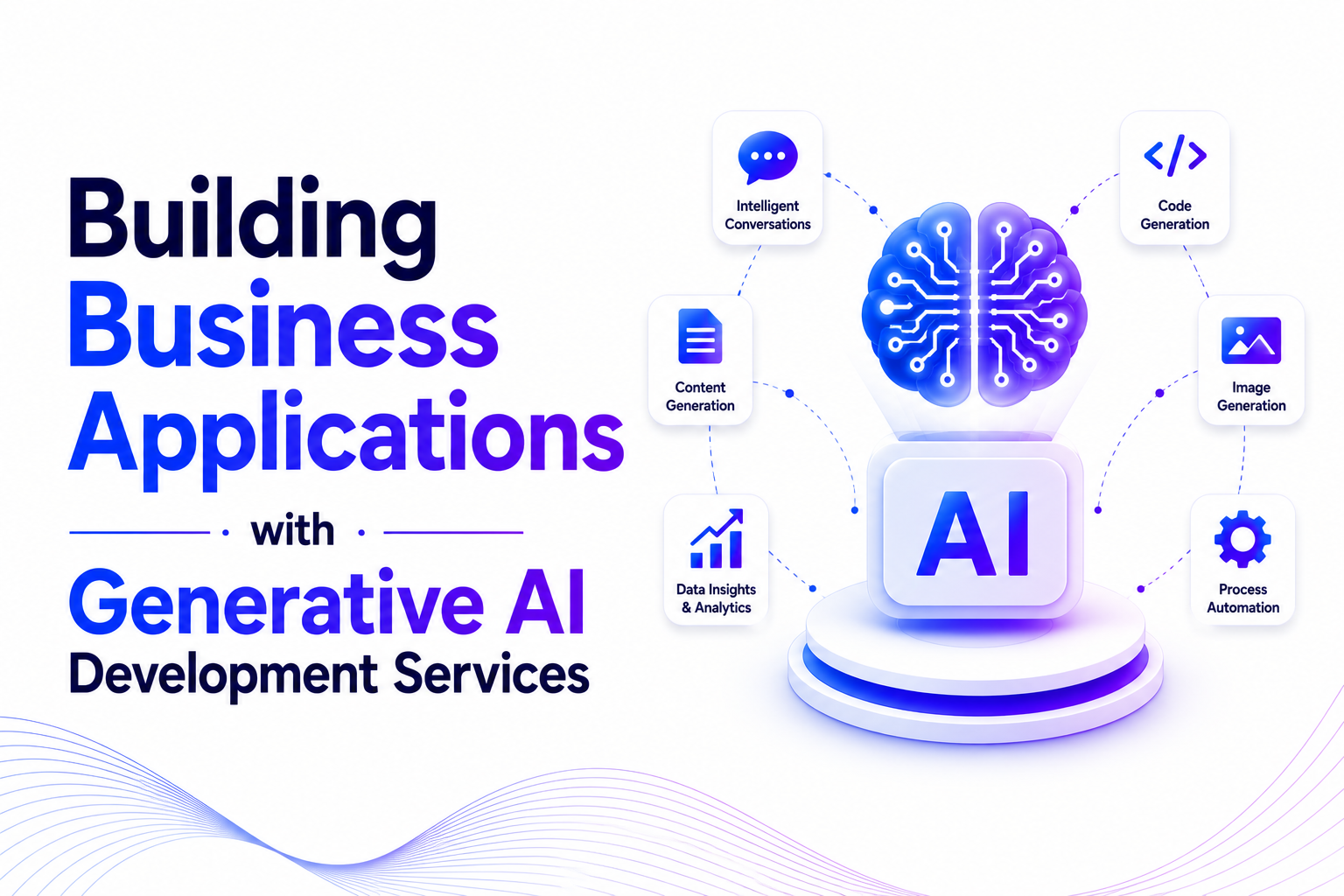
Most companies experimenting with generative AI right now have a chatbot demo and not much else to show for it. The gap between “we tried ChatGPT for a use case” and “we shipped a generative AI application employees actually rely on” is bigger than most leadership teams expect, and it’s almost never about which model you picked.
I’ve watched enough of these projects unfold to know where they usually stall. It’s rarely the model’s fault. It’s the absence of a proper data foundation, a lack of grounding in company-specific information, or an application layer that never got built past the prototype stage. Generative AI development services exist to close exactly that gap, turning a promising demo into something that survives contact with real users and real data.
What Are Generative AI Development Services?
Generative AI development services involve building applications powered by large language models that generate text, code, summaries, or recommendations grounded in a company’s own data, rather than relying on a public chatbot with no business context. The goal is an application that understands your documents, your workflows, and your terminology.
This typically means combining a foundation model, whether from OpenAI, Anthropic, or Google Gemini, with a retrieval layer that connects the model to your actual company data. Without that grounding, a generative AI tool is only as useful as its public training data, which means it won’t know your internal policies, your product catalog, or the specific way your business operates. With it, the same model becomes something that can answer questions about your contracts, summarize your support tickets, or draft content in your company’s voice.
The application layer matters just as much as the model. A generative AI capability sitting behind an API call isn’t a business application. It becomes one once it’s wrapped in an interface people actually use, whether that’s a chat window inside an internal tool, an automated report generator, or an assistant embedded in a CRM.
Why Businesses Are Investing in Generative AI Applications
Businesses are investing in generative AI applications because they reduce the time employees spend on repetitive writing, research, and summarization tasks, while giving customers faster, more personalized responses than static, rule-based systems ever could. The return shows up as time saved and faster turnaround on tasks that used to sit in a queue.
A legal team that used to spend hours summarizing contracts can get a first-pass summary in minutes, with a human reviewing rather than starting from scratch. A support team fielding the same handful of questions repeatedly can hand tier-one tickets to an assistant that already knows the product documentation, freeing people for the harder cases that actually need judgment. Marketing teams use generative AI to produce first drafts of content at a pace that would be impossible manually, then apply human editing and brand judgment on top.
None of this replaces the person doing the work. It changes where their time goes, from the repetitive first pass to the review and decision-making that actually needs a human.
Core Capabilities of Generative AI Development Services
Generative AI development services typically include retrieval-augmented generation for grounding models in company data, custom content generation, AI-powered chat assistants, document summarization, and code generation, with most business applications combining two or more of these capabilities.
Retrieval-augmented generation (RAG) connects a language model to your internal documents so its answers reflect your actual data instead of generic training knowledge. This is the foundation for most enterprise knowledge assistants.
AI-powered chat assistants handle customer support, internal helpdesk questions, or employee onboarding, trained on company-specific documentation rather than generic scripts.
Content generation covers marketing copy, product descriptions, and internal reports, usually with a human review step built into the workflow.
Document summarization condenses contracts, meeting transcripts, or research reports into a format someone can actually read in a few minutes instead of an hour.
Code generation assists development teams with boilerplate code, test cases, and documentation, speeding up parts of the software development cycle that don’t require deep architectural judgment.
How Generative AI Applications Are Built
Building a generative AI application involves selecting a foundation model, connecting it to a company’s data through retrieval-augmented generation, designing the application interface, and integrating the result into existing business systems, with careful testing at every stage to catch inaccurate or inappropriate outputs before launch.
The process starts with choosing the right foundation model for the task and budget. Not every application needs the largest, most expensive model available. A document classification task might run efficiently on a smaller model, while a nuanced customer-facing assistant might justify a larger one. From there, the data layer gets built, typically using a vector database such as Pinecone, Weaviate, or PostgreSQL with the pgvector extension, to store company documents in a format the model can search against in real time.
Application design matters more than most teams expect going in. The interface needs to fit how people already work, whether that’s inside Slack, inside an existing CRM, or as a standalone tool. And testing needs to go beyond checking whether the model gives a reasonable answer. It needs to check what happens when the model doesn’t know something, when a user asks something outside scope, or when the underlying data is incomplete, since generative models will produce a confident-sounding answer even when they shouldn’t.
Generative AI vs Traditional Software Development
Generative AI applications produce dynamic, context-aware outputs based on trained models and retrieved data, while traditional software follows fixed logic that behaves the same way every time regardless of context. The right choice depends on whether the task benefits from flexibility or requires predictable, deterministic behavior.
| Factor | Generative AI Applications | Traditional Software |
|---|---|---|
| Output behavior | Dynamic, context-aware, varies by input | Fixed, predictable, rule-based |
| Best fit | Content generation, summarization, open-ended queries | Structured processes with clear rules |
| Development approach | Model selection, grounding, and prompt design | Direct coding of business logic |
| Maintenance | Requires monitoring for accuracy and drift | Updated only when rules change |
| Data requirements | Needs grounding data for reliable accuracy | Doesn’t depend on external data quality |
| Risk profile | Requires guardrails against inaccurate output | Predictable, lower output-level risk |
Tasks like tax calculations or compliance checks are usually better served by traditional software, since the logic needs to be exact and auditable every time. Tasks like drafting content, summarizing documents, or answering open-ended questions are where generative AI earns its place.
Industries Using Generative AI Development Services
Generative AI development services are being adopted across legal, healthcare, finance, retail, and customer service, with each industry applying the technology to reduce time spent on document-heavy or repetitive language tasks specific to their operations.
Legal: Contract summarization and clause analysis that gives lawyers a starting point instead of a blank page.
Healthcare: Clinical documentation assistance that reduces the administrative burden physicians carry outside patient care.
Finance: Report generation and research summarization that condenses large volumes of market or compliance data into a usable format.
Retail: Product description generation and personalized marketing content at a scale manual writing can’t match.
Customer Service: AI assistants that resolve routine inquiries using company-specific documentation, escalating complex cases to a human.
HR: Job description drafting and policy document summarization for employees navigating internal resources.
Challenges in Generative AI Development
The main challenges in generative AI development are inaccurate or fabricated outputs, weak grounding in company data, and unclear guidelines around what the system should and shouldn’t be trusted to do. Each of these is manageable with the right architecture and review process, but ignoring them leads to tools nobody trusts.
Inaccurate outputs, often called hallucinations, happen when a model generates a confident-sounding answer that isn’t actually correct. Strong retrieval grounding and clear fallback behavior, where the system says it doesn’t know rather than guessing, reduces this significantly.
Weak grounding shows up when a RAG system is built on incomplete or poorly organized company documents. The model can only be as accurate as the data it’s retrieving from, which makes document quality and structure a real engineering concern, not an afterthought.
Unclear scope creates problems when employees don’t know what the AI assistant is actually reliable for. Successful deployments define clear boundaries upfront, communicate them to users, and build in human review for higher-stakes outputs rather than treating every response as final.
How to Choose a Generative AI Development Partner
The right generative AI development partner has real production experience with RAG-based systems, not just prototype work, a clear approach to output accuracy and guardrails, and a track record of building applications that survived contact with real users past the demo stage.
Checklist for evaluating a partner:
- Proven experience deploying generative AI applications in production, not just pilots
- A clear approach to grounding outputs in company data through RAG or fine-tuning
- A defined process for testing accuracy, bias, and failure cases before launch
- Experience integrating with your existing tools and data sources
- Clear guardrails and fallback behavior for uncertain or out-of-scope queries
- Transparent terms on data ownership and model portability
- Direct, specific communication about what the system can and can’t reliably do
Future of Generative AI in Business Applications
Generative AI in business applications is moving toward tighter integration with autonomous AI agents, multimodal capabilities, and private, self-hosted models, shifting from single-response tools toward systems that complete multi-step tasks with a human checkpoint built in where judgment still matters.
Agentic AI represents the clearest shift, where generative capabilities feed into agents that take action across connected systems rather than just producing a response for someone to act on manually. Multimodal AI is expanding what these applications can process, handling text, images, and documents together instead of text alone, which matters for industries where visual data carries as much weight as written content. Private LLMs are gaining adoption among enterprises that want generative capabilities without routing sensitive data through public APIs, and AI governance, covering accuracy standards and explainability, is becoming a standard part of how these applications get approved and deployed internally.
Conclusion
A generative AI application only earns its place in a business once it’s grounded in real company data, wrapped in an interface people actually use, and tested for what happens when it doesn’t know the answer. That’s a different project than a chatbot demo, and it’s exactly the work generative AI development services are built to handle.
If your team is weighing a generative AI initiative against another quarter of experimenting with a public chatbot, it’s worth a direct conversation about your data readiness and the specific workflow you want the application to support, before committing to a build.
Frequently Asked Questions
What are generative AI development services?
Generative AI development services involve building applications powered by large language models that generate text, summaries, or recommendations grounded in a company’s own data, rather than relying on a generic public chatbot.
How is generative AI different from traditional machine learning?
Generative AI produces new content, such as text, code, or summaries, while traditional machine learning typically focuses on prediction, classification, or pattern detection from structured data.
What is retrieval-augmented generation, and why does it matter?
RAG connects a language model to a company’s own documents so its answers reflect actual business data instead of only the model’s general training knowledge, significantly improving accuracy for business use cases.
How long does it take to build a generative AI application?
Timelines depend on data readiness and the complexity of the application. A focused pilot, such as an internal knowledge assistant, can launch in a few months, while broader deployments take longer.
Can generative AI applications integrate with our existing software?
Yes. Most generative AI applications are built to connect with existing tools like CRMs, internal wikis, and ticketing systems, so the AI’s output fits directly into a workflow employees already use.
How do we prevent inaccurate or fabricated outputs?
Strong retrieval grounding, clear fallback behavior when the system is uncertain, and human review for higher-stakes outputs are the standard ways to reduce inaccurate responses.
Is it safe to use generative AI with sensitive company data?
It can be, provided the application is built with proper data governance, access controls, and, for highly sensitive data, private or self-hosted model infrastructure rather than public APIs.
Should smaller businesses invest in generative AI development?
Yes, if there’s a clear, well-defined use case, such as document summarization or customer support. It doesn’t require a large-scale rollout to start; many businesses begin with a single, scoped application.


 paulmark321 saurabh
 hemant kumar