OM Jewels Inc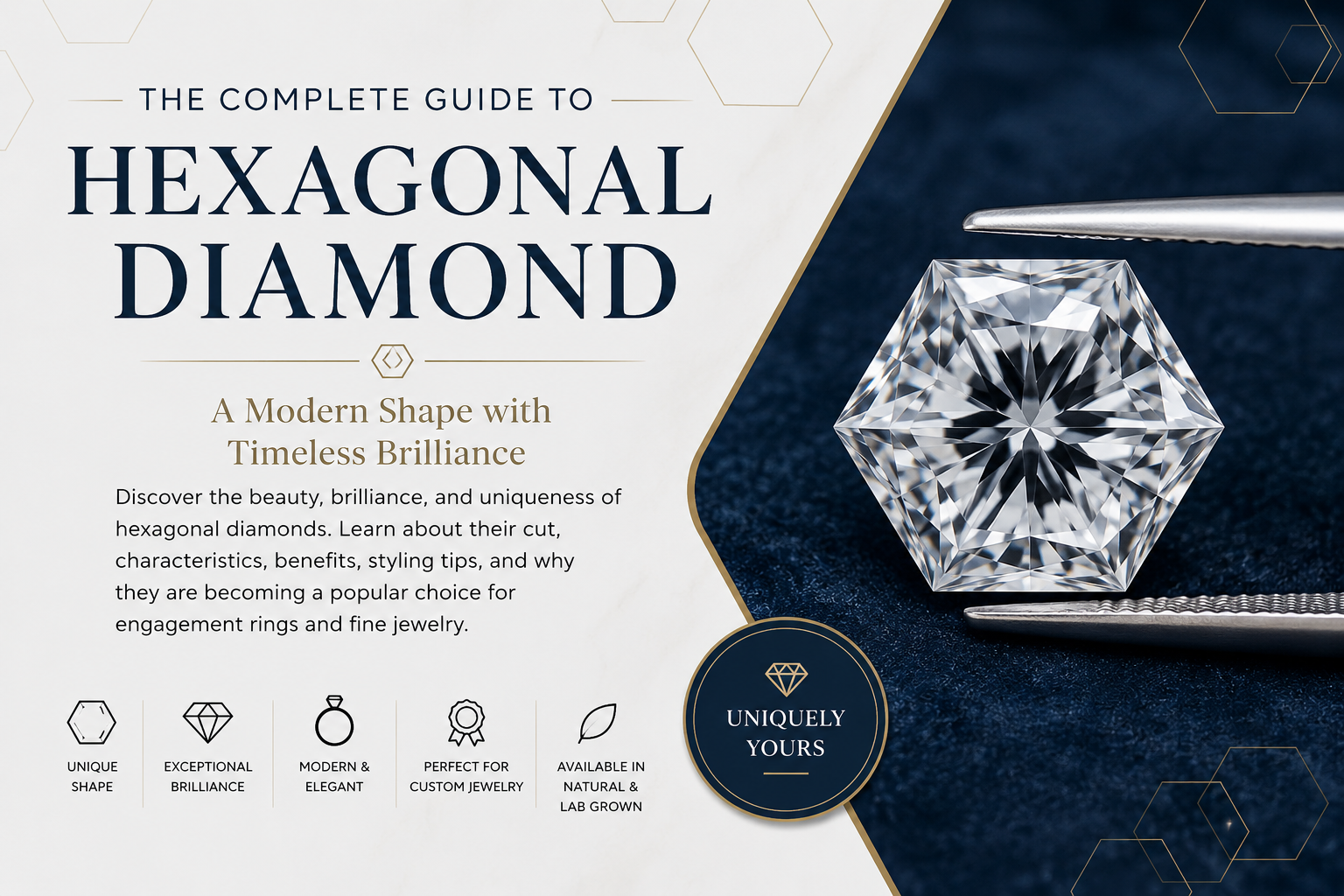
If you’ve heard whispers about a material “harder than diamond” and wondered whether it’s hype or hard science, this guide is for you. The hexagonal diamond – known scientifically as – has gone from meteorite curiosity to laboratory reality, and it’s poised to become one of the most important materials of the coming decades. Here’s everything you need to know, from the basics to the breakthroughs.
What Is a Hexagonal Diamond?
A hexagonal diamond is an allotrope of carbon – the same element that makes up graphite, ordinary diamond, and the graphene in your pencil lead. Like a conventional diamond, every carbon atom in bonds tightly to four neighbors. The crucial difference lies in how the atomic layers stack.
In an ordinary (cubic) diamond, the carbon layers repeat in a three-layer pattern: ABC, ABC, ABC. In a hexagonal diamond, they repeat in a two-layer pattern: AB, AB, AB. That single change gives the crystal hexagonal symmetry instead of cubic symmetry — and dramatically different properties.
Think of it like brickwork. Two walls can be built from identical bricks, but the way you stagger them determines how strong the wall is. Same bricks, different bond, different building.
How Was It Discovered?
The story starts with a catastrophe. Roughly 49,000 years ago, an iron meteorite struck what is now northern Arizona, gouging out the landmark Meteor Crater. When scientists studied fragments of that meteorite — the Canyon Diablo specimen – in the 1960s, they found tiny carbon crystals that matched neither graphite nor ordinary diamond.
The new mineral was named after Dame Kathleen Lonsdale, a trailblazing crystallographer and one of the first two women elected as Fellows of the Royal Society. The extreme heat and pressure of the meteorite impact had transformed graphite in the rock into this exotic hexagonal form of diamond in an instant.
Since then, traces of have been identified at other impact sites, including the crater in Siberia, formed by an asteroid strike about 35 million years ago.
Is It Really Harder Than Diamond?
This is the question everyone asks – and the honest answer is: very likely, yes.
Theoretical calculations have suggested for years that hexagonal structure could make it as much as 58% harder than cubic diamond under certain conditions, along with greater stiffness. The catch was that nobody could test it properly, because pure samples simply didn’t exist. Natural occurs only as nanoscale grains mixed with regular diamond, far too small and contaminated for reliable hardness measurements.
That changed with recent breakthroughs (more on those below). Early measurements on newly synthesized pure crystals suggest hexagonal diamond may indeed be harder and stiffer than conventional diamond – which would make it the hardest known material.
Why Was It So Controversial?
For nearly sixty years, lived a double life: celebrated by some scientists, dismissed by others.
The skeptics had a fair point. Every claimed sample – whether from meteorites or lab experiments – was either microscopic, impure, or ambiguous. Some researchers argued that was nothing more than ordinary cubic diamond riddled with stacking faults, a defect masquerading as a new mineral. Even sophisticated tools like X-ray diffraction and electron microscopy struggled to settle the matter, because a heavily faulted cubic diamond and a true hexagonal diamond can look frustratingly similar.
Adding to the difficulty, studies suggested that making pure might require shock compression above 170 gigapascals and temperatures of 6,000–7,000 °C – conditions resembling a meteor impact more than a manageable lab experiment.
How Is It Made? The Breakthrough
The turning point came in 2025, when a Chinese research team published a landmark paper in Nature announcing the synthesis of bulk hexagonal diamond.
Their approach, in simplified terms, involved three key steps. First, they prepared well-ordered graphite as a starting material, because the quality of the carbon layers going in determines the quality of the crystal coming out. Second, they applied carefully controlled high pressure and heat, effectively recreating impact-like conditions in a precise, tunable way. Finally, they verified the result with X-ray diffraction and advanced microscopy to confirm the crystals were genuinely hexagonal rather than defective cubic diamond.
The result: pure, highly ordered crystals about 1.5 millimeters across – an unprecedented size for a material that had previously existed only at the nanoscale. For the first time, scientists could hold a testable piece of , and the decades-long debate about its existence was finally put to rest.
Earlier milestones paved the way, including a 2016 experiment that produced nanocrystalline from glassy carbon in a diamond anvil cell at around 100 gigapascals, and a 2025 effort by researchers at Jilin and Sun Universities that yielded nearly pure hexagonal diamond.
What Can Hexagonal Diamonds Be Used For?
Don’t expect engagement rings – this material’s destiny is industrial and technological. The most promising applications include superhard cutting, drilling, and machining tools that outlast diamond-tipped equipment; wide-bandgap semiconductors for electronics that operate in extreme heat, radiation, and high-voltage environments such as aerospace systems and power infrastructure; protective coatings for components in punishing conditions where ordinary materials fail; and next-generation quantum materials, where researchers are exploring its unique electronic properties.
Because combines extreme hardness with excellent thermal behavior, it could eventually go wherever conventional diamond goes today – and places diamond can’t.
Hexagonal vs. Cubic Diamond at a Glance
Both are pure carbon with four-fold atomic bonding, but they part ways from there. Cubic diamond has ABC-ABC layer stacking, cubic symmetry, forms naturally deep in the Earth’s mantle, and has been synthesized industrially since the 1950s. Hexagonal diamond has AB-AB stacking, hexagonal symmetry, forms naturally only in violent impact events, resisted pure synthesis until the 2020s — and, according to theory and early tests, takes the hardness crown. Read More
Frequently Asked Questions
Is a real diamond? It’s a real diamond in the sense that matters: a crystal of pure carbon with full four-fold bonding. It’s simply a different polymorph – the same ingredients arranged in a different pattern.
Can I buy hexagonal diamond? Not yet. Current samples are research materials measured in millimeters. Commercial production will require scaling up synthesis, which is now an active area of materials research.
Where does it occur naturally? Only at meteorite and asteroid impact sites, where shock pressures and temperatures were high enough to convert graphite into the hexagonal phase.
Who is it named after? Dame Kathleen Lonsdale (1903–1971), the Irish-born crystallographer who proved the benzene ring is flat and broke barriers for women in science.
The Bottom Line
The hexagonal diamond is one of materials science’s great redemption stories: a mineral born in cosmic violence, doubted for half a century, and finally vindicated in the lab. With pure crystals now in hand, researchers can begin turning its extraordinary theoretical properties into real-world tools, chips, and coatings. Diamond has ruled the hardness charts for millennia – but its hexagonal sibling is coming for the throne.

 hemant kumar
 Daniel Jack