
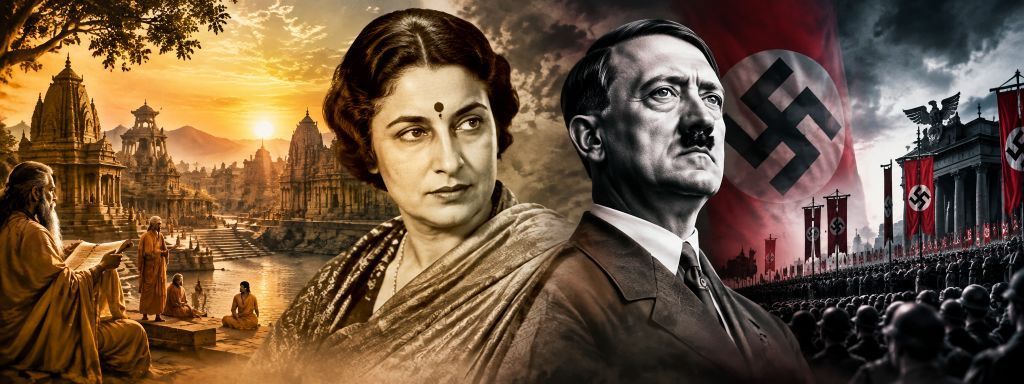
On June 15, 1948, a train crossed from Denmark into occupied Germany. The country was still devastated by war. Cities remained buried beneath piles of rubble, while the concentration camps had been liberated, documented and presented during the postwar trials. In the American and British occupation zones, posters promoting denazification were everywhere.
Among the passengers was a 42-year-old woman travelling with an Indian dance troupe. Born in Greece as Maximiani Portas and holding a French passport, she had adopted the name Savitri Devi. Hidden among her belongings were Nazi leaflets, initially handwritten, which she distributed on the train along with cigarettes and small quantities of food.
She was eventually caught, prosecuted and sentenced to three years in Werl prison.
There was something almost absurd about the image: a woman dressed in a sari travelling through the Ruhr region, trying to preach Nazi ideas to Germans whose immediate concerns were coal and food. But Savitri Devi was entirely serious.
Hitler's defeat did not embarrass her.
Within her worldview, his defeat actually strengthened the case for his importance.
A French Woman Searching for India
Long before she became an advocate of Hitler, Portas was a European classicist deeply hostile to modernity.
Born in Lyon in 1905, she developed an intense admiration for ancient Greece. She rejected Christianity, industrialisation and equality, and became attracted to racial theories at an early stage.
She did not travel to India and suddenly become a fascist.
She already held fascist beliefs.
India provided the cultural framework she needed to develop them further.
Her interpretation of Hinduism was highly selective. She showed little interest in traditions such as bhakti or Vedanta when they did not support her ideas. Instead, she focused on caste, interpreting it through a racial lens, as well as the Aryan past and, most importantly, the idea of cyclical time.
She arrived in India during the 1930s, studied Sanskrit with considerable enthusiasm, and married Asit Krishna Mukherji, a Bengali Brahmin who published The New Mercury in Calcutta, a publication that openly supported Hitler and Japan.
Declassified British intelligence records identified both Mukherjis as suspected Axis sympathisers.
The marriage gave Savitri Devi something she considered especially valuable: a connection to what she regarded as a living Aryan tradition.
She could now present herself not simply as a European projecting her ideas onto India, but as someone connected by marriage to the civilisation she believed represented the surviving Aryan tradition.
From there, her reasoning became increasingly direct.
If India represented the last surviving Aryan civilisation and Hitler was attempting to revive Aryan civilisation in Europe, she concluded that the two belonged to the same historical story.
Hitler and the Kali Yuga
The Hindu concept of the yugas fitted naturally into Savitri Devi's worldview.
In Puranic cosmology, time does not move endlessly toward progress. Instead, it moves through cycles.
Satya Yuga represents a golden age in which dharma stands firmly on four legs. It is followed by Treta Yuga, Dvapara Yuga and finally Kali Yuga, the dark age in which dharma has been reduced to one leg and society is characterised by decline, conflict and shortened lives.
For someone looking at the world of the 1930s through that framework, the circumstances could appear to confirm the theory.
Economic collapse, political violence and unstable empires could all be interpreted as symptoms of a civilisation descending into Kali Yuga.
Hindu traditions also contain the concept of avatars, divine descents that occur when dharma declines.
Krishna is one example, while Kalki is traditionally associated with the end of Kali Yuga, arriving on a white horse with a sword to restore order.
No Indian guru told Savitri Devi that Hitler was an avatar.
The Nazis did not believe this either.
The idea was entirely her own.
She developed it most explicitly in The Lightning and the Sun, published in 1958, where she divided significant historical figures into three categories.
Men in Time
These were figures who moved with the decline of their historical period. They were successful because they understood and benefited from the conditions of their age.
Napoleon could be placed somewhere within this category.
Men Above Time
These individuals represented timeless truths but were unable to translate those beliefs into lasting practical change.
Akhenaten, who attempted to establish monotheism in ancient Egypt, and Genghis Khan, who conquered vast territories without creating an enduring system in the way Savitri Devi imagined it, were examples.
Men Against Time
This was the category she valued most.
These were individuals who recognised that their age was corrupt and attempted to oppose it, even while knowing that defeat was likely.
They sought to force a return to a golden age.
They were violent, tragic and doomed, but Savitri Devi regarded them as almost sacred because of their opposition to the historical forces around them.
For her, Hitler was the ultimate Man Against Time.
The theory created a closed circle.
If Hitler had won, his victory would supposedly have demonstrated that Aryan order could be restored.
But he lost.
He died by suicide in his Berlin bunker as the city around him collapsed.
For Savitri Devi, however, that defeat did not disprove her belief. Instead, it transformed him into a martyr who had sacrificed himself while fighting impossible odds.
Failure itself became evidence of his cosmic significance.
The question was no longer whether his policies had succeeded or whether they had improved people's lives.
The question became which historical age he supposedly represented.
Military catastrophe had been transformed into theology.
What About the Holocaust?
This is where her worldview became more extreme.
If history was understood as a racial conflict and Hitler was presented as an avatar defending the Aryan race during its darkest period, then the people who suffered under his regime could not simply remain innocent victims within that framework.
They had to be transformed into enemies.
Otherwise the entire system of belief would collapse.
Her writings therefore moved toward racial denial and minimisation. These ideas were not peripheral to her worldview. They were necessary for it.
If Jews were portrayed as an anti-Aryan force responsible for the destruction of dharma, then their persecution and murder could be reinterpreted within her ideology rather than acknowledged as crimes.
Savitri Devi did not command a state or an army.
She had no militia, no meaningful political power and no major newspaper through which to exercise influence.
Yet her ideas demonstrate how an ideology can survive defeat by turning itself into theology.
The camps had been liberated. Evidence of Nazi crimes had been presented at Nuremberg. Yet she could still reject or minimise that evidence because accepting it would destroy the worldview she had constructed.
Her imprisonment in Werl became another part of that mythology.
There she encountered former SS members serving sentences and developed relationships with them. In her prison memoir, Defiance, she described befriending them, encouraging them and treating her prison surroundings almost like an ashram.
She was released early, in August 1949.
There have been accounts suggesting that her husband may have intervened and that someone may have contacted Nehru's office regarding her release. Those claims have never been conclusively established.
The Pilgrimage, the Swastika and the Afterlife
Savitri Devi was banned from Germany for five years.
She eventually violated that ban.
In 1953, using a Greek passport in her maiden name, she returned to Germany and remained there for almost four years, spending part of that period in Emsdetten, Westphalia, among sympathisers.
This time, she was not distributing leaflets.
She was on a pilgrimage.
She visited locations associated with the Nazi movement, including Berchtesgaden and the Feldherrnhalle, places connected with the movement's history.
She later described the journey in Pilgrimage, published in 1958.
By this stage, Nazism had ceased to be merely a political ideology for her.
It had become metaphysical.
Germany was no longer simply a nation that had lost a war. It had become a sacred landscape that had undergone a historical trial.
Hitler was no longer simply a defeated dictator.
He had become, in her worldview, an instrument of cosmic time.
The swastika helped make the connection between India and Nazism appear natural within her interpretation.
In India, the swastika had existed for thousands of years as an auspicious symbol associated with traditions including Hinduism and Jainism.
The Nazis appropriated a hooked version, rotated it and placed it on their red flag. After 1945, the symbol became deeply associated with Nazi rule and genocide.
Savitri Devi attempted to reverse that historical association.
She argued that the Nazi symbol represented an ancient Aryan sun-wheel, that Hitler had reunited two branches of the Aryan tradition, that India had preserved its memory and that Germany had transformed it into political action.
In India, however, she attracted little attention.
Her audience was elsewhere.
It consisted largely of people in postwar Europe and later America who wanted to preserve Nazi beliefs despite the movement's defeat and criminal reputation.
She offered them something more powerful than a political programme.
She offered a narrative in which winning was no longer necessary.
The Kali Yuga was still continuing.
The supposed racial conflict was still unfinished.
Hitler had not failed; he had become a martyr.
History could therefore still be interpreted as being on their side even when contemporary events appeared to demonstrate the opposite.
For a movement that had been defeated and prosecuted, that narrative transformed failure into doctrine.
And Then There Is India
It would be tempting to draw a direct line from Savitri Devi to contemporary Hindu nationalism.
That would be an oversimplification.
She was a European fascist who used a highly selective and racialised interpretation of Hinduism to support her admiration for Hitler.
Being interested in Hindu civilisation or identifying with Hindu nationalism does not make someone a Nazi.
Most Hindu nationalists have never read Savitri Devi and may never have encountered her ideas.
Yet the historical connections cannot simply be ignored.
The decades in which European thinkers were debating Aryan ancestry were also decades when Indian thinkers were wrestling with another difficult question:
Why had such an ancient civilisation ended up under British colonial rule?
Different thinkers offered different answers.
Sarda argued that India had once civilised the West before subsequently declining.
Tilak proposed an Arctic origin for the Aryans.
Savarkar developed the idea of Hindutva around territorial and ancestral connections.
Golwalkar, in We, or Our Nationhood Defined, published in 1939, described Hindus as the indigenous race of Hindustan and also referred to Germany's treatment of Jews as an example relevant to preserving racial purity.
That passage remains controversial and widely criticised.
It does not make Golwalkar's movement an exact replica of Nazism. Its concerns were rooted in Indian political circumstances and its understanding of its opponents developed within that context.
But it demonstrates that ideas surrounding race, nation and ancient ancestry were circulating internationally during the period.
Indian thinkers were engaging with the same broader intellectual environment.
Savitri Devi represents an extreme point where several of these ideas collided.
When History Becomes Identity
India continues to have serious historical debates about subjects such as migration, the Indus Valley civilisation and Sanskrit.
Some of these debates involve legitimate questions and evidence-based disagreement.
The problem begins when political objectives start determining historical conclusions.
The desire to establish who was first, who belongs most authentically and who possesses the strongest claim to the past can transform historical inquiry into a contest over identity.
That is where the older Aryan fantasy can continue to survive.
Not because modern nationalism secretly regards Hitler as an avatar of Vishnu.
It does not.
Rather, Savitri Devi's life illustrates what can happen when history stops being something to investigate and becomes something people believe they inherit through blood.
She took a European racial interpretation of the past, found what she believed was an Indian parallel, combined the two and ultimately proclaimed Adolf Hitler an avatar of Vishnu.
The idea sounds absurd.
Yet people believed it.
And in scattered online communities and small publishing circles, some still do.
That is the enduring lesson of Savitri Devi's story: a political movement can be defeated militarily and politically while an ideology survives by transforming defeat itself into a sacred narrative.